
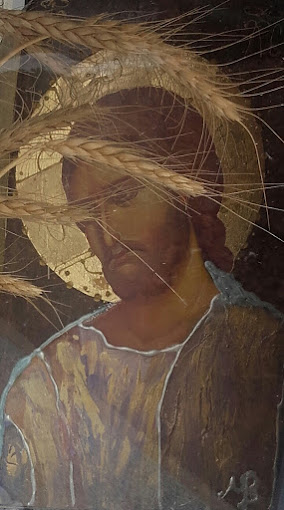

St. John Chrysostom on Job's Suffering as Consolation
On both sides, beloved, reap the utmost gain, and avoid the imitation of Adam knowing how many ills are begotten of laziness and imitate the piety of Job, learning how many glorious things spring from earnestness. Consider him, the conqueror throughout, and you shall have much consolation in all pain and peril. For as it were in the common theatre of the world that blessed and noble man stands forth, and by means of the sufferings which happened to him, discourses to all to bear all things which befall them nobly and never give in to the troubles which come upon them. For verily, there is no human suffering which cannot receive consolation as a result. For the sufferings which are scattered over the whole world,
these came together, and bore down upon one body, that of Job. What pardon then shall there be for him who is unable to bear with thankfulness his share of the troubles which are brought upon him? Since he appears not bearing a part only, but the entire ills of all men, and in order that you may not condemn the extravagance of my words, come, and let us take in hand severally the ills that came upon him, and bring forward this fulfillment of them.And if you wish, let us first bring forward that which seems to be the most unendurable of all, I mean poverty, and the pain which arises from it. For everywhere all men bewail this. Who was poorer, then, than Job, who was poorer than the outcasts at the baths and those who sleep in the ashes of the furnace, poorer in fact than all men? For these, indeed, have one ragged garment, but he sat naked, and had only the garment which nature supplies, the clothing of the flesh, and this the Devil destroyed on all sides with a distressing kind of decay. Again, these poor folk are at least under the roof of the porches at the baths and are covered with a shelter, but he continued always to pass his nights in the open air, not having even the consolation of a bare roof. And what is still greater, the fact that these are conscious of many terrible evils within themselves, but he was conscious of nothing against himself. For this is to be noticed in each of the things which happened to him, a thing which caused him greater pain, and produced more perplexity; the ignorance of the reason of what took place. These persons, then, as I said, would have many things with which to reproach themselves. And this contributes much to consolation in calamity; to be conscious in oneself of being punished justly. But he was deprived of this consolation, and while exhibiting a conversation full of virtue, endured the fate of those who had dared to do extreme wickedness. And these folk who are with us, are poor from the outset, and from the beginning are experienced in calamity. But he endured calamity in which he was unexperienced, undergoing the immense change from wealth. As then the knowledge of the cause of what takes place, is the greatest consolation; so it is not less than this, to have been experienced in poverty from the beginning and so to continue in it. Of both these consolations that man was deprived, and not even then, did he fall away. Do you see him indeed come to extreme poverty, even in comparison with which it is impossible to find a fellow? For what could be poorer than the naked who has not even a roof over him? Yes rather not even was it in his power to enjoy the bare ground, but he sat upon the dunghill. Therefore whenever you see yourself come to poverty, consider the suffering of the just one, and straightway you shall rise up, and shake off every thought of despondency. This one calamity therefore seems to men to be the groundwork of all sufferings together.
And the second after it, yes rather before it, is the affliction of the body. Who then was even so disabled? Who endured such disease? Who received or saw any one else receive so great an affliction? No one. Little by little, his body was wasted, and a stream of worms on every side issued from his limbs; the running was constant; the evil smell which surrounded him was strong, the body being destroyed little by little, and decaying with such putrefaction, used to make food distasteful; and hunger was to him strange and unusual. For not even was he able to enjoy the nourishment which was given to him. For he says, “I see my food to be loathsome” (Job 6:7). Whenever, then, you fall into weakness, O man, remember that body and that saintly flesh, for it was saintly and pure, even when it had so many wounds. And if any one belong to the army, and then unjustly and without any reasonable pretext, be hanged upon the pillory2, and has his sides rasped to pieces, let him not think the matter to be a reproach, nor let him give way to the pain when he thinks upon this saint. But this man, says one, has much comfort and consolation in knowing that God was bringing these sufferings upon him. This indeed especially troubled and disturbed him, to think that the just God Who had in every way been served by him was at war with him. And he was not able to find any reasonable pretext for what took place, since, when at least he afterwards learned the cause, see what piety he showed, for when God said to him “Do you think that I have had dealings with you in order that you might appear righteous?” (Job 40:8), he says while conscious-stricken, “I will lay my hand upon my mouth, once have I spoken but to a second word I will not proceed,” (Job 40:4, 5), and again “as far as the hearing of the ear I have heard you before, but now mine eye has seen you, wherefore I have held myself to be vile, and am wasted away, and I consider myself to be earth and ashes” (Job 42:5, 6).
But if you think that this is sufficient for consolation, you will yourself also be able to experience this comfort. And even if you do not suffer any of these misfortunes at the hands of God, but owing to the insolence of men — and yet give thanks and do not blaspheme Him Who is able to prevent them indeed, but Who permits them for the sake of testing you — just as they who suffer at the hands of God are crowned, so also you shall obtain the same reward, because you have borne nobly the calamities which were brought upon you from men and did give thanks to Him Who was able indeed to hinder them, but not willing.
Behold, then! You have seen poverty and disease, and both in the extremest degree brought upon this just man. Do you wish that I should show you the warfare at nature’s hands, in such excessive degree waged then against this noble man? He lost ten children, the ten at one fell swoop, the ten in the very bloom of youth, ten who displayed much virtue, and that not by the common law of nature, but by a violent and pitiable death. Who could be able to recount so great a calamity? No one. Whenever, therefore, you lose son and daughter together, have recourse to this just man, and you shall find altogether much comfort for yourself. Were these, then, the only misfortunes which happened to him? The desertion and treachery of his friends, the gibes, raillery, mockery and derision, and the tearing in pieces by all was something intolerable. For the character of calamities is not of such a kind, that they who reproach us about our calamities are inclined to vex our soul. Not only was there no one to soothe him, but many from all sides troubled him with taunts. And you see him lamenting this bitterly and saying, “but even you, too, fell upon me” (Job 19:5). He calls them pitiless and says, “My neighbors have rejected me, and my servants spoke against me, and I called the sons of my concubines, and they turned away from me” (Job 19:14, 16). “And others,” he says, “sport upon me, and I became the common talk of all (Job 19:9, 10). And my very raiment,” he says, “abhorred me” (Job 9:31). These things at least are unbearable to hear, still more to endure in their reality, extreme poverty, and intolerable disease new and strange, the loss of children so many and so good, and in such a manner, reproaches and gibes, and insults from men. Some indeed mocked, some reproached, and others despised; not only enemies, but even friends; not only friends, but even servants, and they not only mock and reproach, but even abhorred him, and this not for two or three, or ten days, but for many months; and (a circumstance which happened in that man’s case alone) not even did he have comfort by night, but the delusions of terrors by night were a greater aggravation of his misfortunes by day. For that he endured more grievous things in his sleep, hear what he says “why do you frighten me in sleep, and terrify me in visions?” (Job 7:14). What man of iron, what heart of steel could have endured so many misfortunes? For if each of these was unbearable in itself, consider what a tumult their simultaneous approach excited. But nevertheless he bore all these, and in all that happened to him he sinned not, nor was there guile in his lips.
Let the sufferings of that man then be the medicines for our ills, and his grievous surging sea the harbor of our sufferings, and in each of the accidents which befall us, let us consider this saint, and seeing one person exhausting the misfortunes of the universe, we shall conduct ourselves bravely in those which fall to our share, and as to some affectionate mother, stretching forth her hands on all sides, and receiving and reviving her terrified children, so let us always flee to this book, and even if the pitiable troubles of all men assail us, let us take sufficient comfort for all and so depart. And if you sayest, he was Job, and for this reason bore all this, but I am not like him; you supply me with a greater accusation against yourself and fresh praise of him. For it is more likely that you should be able to bear all this than he. Why, you ask? Because he indeed was before the day of grace and of the law, when there was not much strictness of life, when the grace of the Spirit was not so great, when sin was hard to fight against, when the curse prevailed and when death was terrible. But now our wrestlings have become easier, all these things being removed after the coming of Christ; so that we have no excuse, when we are unable to reach the same standard as he, after so long a time, and such advantage, and so many gifts given to us by God. Considering therefore all these things, that misfortunes were greater for him, and that when the conflict was more grievous, then he stripped for the contest; let us bear all that comes upon us nobly, and with much thankfulness, in order that we may be able to obtain the same crown as he, by the grace and lovingkindness of Jesus Christ our Lord, with whom be glory to the Father together with the Holy Spirit, now and always and for ever and ever. Amen.
https://full-of-grace-and-truth.blogspot.com/
<>
God loves us more than a father, mother, friend, or any else could love, and even more than we are able to love ourselves.
+ St. John Chrysostom
<>
"Do not therefore be cast down..."
Excerpt from St. John Chrysostom's letter to St. Olympia
"Come now let me relieve the wound of your despondency, and disperse the thoughts which gather this cloud of care around you. For what is it which upsets your mind, and why are you sorrowful and dejected? Is it because of the fierce black storm which has overtaken the Church, enveloping all things in darkness as of a night without a moon, and is growing to a head every day, travailing to bring forth disastrous shipwrecks, and increasing the ruin of the world? I know all this as well as you; none shall gainsay it, and if you like I will form an image of the things now taking place so as to present the tragedy yet more distinctly to you. We behold a sea upheaved from the very lowest depths, some sailors floating dead upon the waves, others engulfed by them, the planks of the ships breaking up, the sails torn to tatters, the masts sprung, the oars dashed out of the sailors' hands, the pilots seated on the deck, clasping their knees with their hands instead of grasping the rudder, bewailing the hopelessness of their situation with sharp cries and bitter lamentations, neither sky nor sea clearly visible, but all one deep and impenetrable darkness, so that no one can see his neighbour, while mighty is the roaring of the billows, and monsters of the sea attack the crews on every side.
"But how much further shall I pursue the unattainable? For whatever image of our present evils I may seek speech shrinks baffled from the attempt. Nevertheless even when I look at these calamities I do not abandon the hope of better things, considering as I do who the pilot is in all this — not one who gets the better of the storm by his art, but calms the raging waters by his rod. But if He does not effect this at the outset and speedily, such is His custom — He does not at the beginning put down these terrible evils, but when they have increased, and come to extremities, and most persons are reduced to despair, then He works wondrously, and beyond all expectation, thus manifesting his own power, and training the patience of those who undergo these calamities. Do not therefore be cast down. For there is only one thing, Olympias, which is really terrible, only one real trial, and that is sin; and I have never ceased continually harping upon this theme; but as for all other things, plots, enmities, frauds, calumnies, insults, accusations, confiscation, exile, the keen sword of the enemy, the peril of the deep, warfare of the whole world, or anything else you like to name, they are but idle tales. For whatever the nature of these things may be they are transitory and perishable, and operate in a mortal body without doing any injury to the vigilant soul. Therefore the blessed Paul, desiring to prove the insignificance both of the pleasures and sorrows relating to this life, declared the whole truth in one sentence when he said — “For the things which are seen are temporal.” 2 Corinthians 4:18 Why then do you fear temporal things which pass away like the stream of a river. For such is the nature of present things whether they be pleasant or painful. And another prophet compared all human prosperity not to grass, but to another material even more flimsy, describing the whole of it “as the flower of grass.” For he did not single out any one part of it, as wealth alone, or luxury alone, or power, or honour; but having comprised all the things which are esteemed splendid among men under the one designation of glory he said “all the glory of man is as the flower of grass.” Isaiah 40:6
"Nevertheless, you will say, adversity is a terrible thing and grievous to be borne. Yet look at it again compared with another image and then also learn to despise it. For the railings, and insults, and reproaches, and gibes inflicted by enemies, and their plots are compared to a worn-out garment, and moth-eaten wool when God says “Fear ye not the reproach of men, neither be ye afraid of their revilings, for they shall wax old as does a garment, and like moth-eaten wool so shall they be consumed.” Isaiah 50:7-8 Therefore let none of these things which are happening trouble you, but ceasing to invoke the aid of this or that person, and to run after shadows (for such are human alliances), do thou persistently call upon Jesus, whom you serve, merely to bow his head; and in a moment of time all these evils will be dissolved. But if you have already called upon Him, and yet they have not been dissolved, such is the manner of God's dealing (for I will resume my former argument); He does not put down evils at the outset, but when they have grown to a head, when scarcely any form of the enemy's malice remains ungratified, then He suddenly converts all things to a state of tranquillity and conducts them to an unexpected settlement. For He is not only able to turn as many things as we expect and hope, to good, but many more, yea infinitely more. Wherefore also Paul says “now to Him who is able to do exceeding abundantly above all that we ask or think.” Ephesians 3:20 Could He not, for example, have prevented the three children at the outset from falling into trial? But He did not choose to do this, thereby conferring great pain upon them. Therefore He suffered them to be delivered into the hands of barbarians, and the furnace to be heated to an immeasurable height and the wrath of the king to blaze even more fiercely than the furnace, and hands and feet to be bound with great severity and they themselves to be cast into the fire; and then, when all they who beheld despaired of their rescue, suddenly, and beyond all hope, the wonder-working power of God, the supreme artificer, was displayed, and shone forth with exceeding splendour. For the fire was bound, and the bondmen were released; and the furnace became a temple of prayer, a place of fountains and dew, of higher dignity than a royal court, and the very hairs of their head prevailed over that all devouring element which gets the better even of iron and stone, and masters every kind of substance. And a solemn song of universal praise was instituted there by these holy men inviting every kind of created thing to join in the wondrous melody; and they uttered hymns of thanksgiving to God for that they had been bound, and also burnt, as far at least as the malice of their enemies had power; that they had been exiles from their country, captives deprived of their liberty, wandering outcasts from city and home, sojourners in a strange and barbarous land; for all this was the outpouring of a grateful heart. And when the malicious devices of their enemies were perfected (for what further could they attempt after their death?) and the labours of the heroes were completed, and the garland of victory was woven, and their rewards were prepared and nothing more was wanting for their renown; then at last their calamities were brought to an end, and he who caused the furnace to be kindled, and delivered them over to that great punishment, became himself the panegyrist of those holy heroes, and the herald of God's marvellous deed, and everywhere throughout the world issued letters full of reverent praise, recording what had taken place, and becoming the faithful herald of the miracles wrought by the wonder-working God. For inasmuch as he had been an enemy and adversary what he wrote was above suspicion even in the opinion of enemies.
"Do you see the abundance of resource belonging to God? His wisdom, His extraordinary power, His loving-kindness and care? Be not therefore dismayed or troubled but continue to give thanks to God for all things, praising, and invoking Him; beseeching and supplicating; even if countless tumults and troubles come upon you, even if tempests are stirred up before your eyes let none of these things disturb you. For our Master is not baffled by the difficulty, even if all things are reduced to the extremity of ruin..."
<>
“Let everything take second place to our care of our children, our bringing them up to the discipline and instruction of the Lord. If from the beginning we teach them to love true wisdom, they will have great wealth and glory than riches can provide."
-St. John Chrysostom
<>
"For it was to Him no lowering to put on what He Himself had made. Let that handiwork be forever glorified, which became the cloak of its own Creator. For as in the first creation of flesh, man could not be made before the clay had come into His hand, so neither could this corruptible body be glorified, until it had first become the garment of its Maker."
-St. John Chrysostom, "Sermon on the Nativity"
<>
St. John Chrysostom: "Unspeakable is the power of the Cross..."
"Unspeakable is the power of the Cross. For that being actually in the midst of horrors, He should have shown Himself above all horrors; and being in the enemy's hold should have overcome; this comes of Infinite Power. For as in the case of the Three Children, their not entering the furnace would not have been so astonishing, as that having entered in they trampled upon the fire—and in the case of Jonah, it was a greater thing by far, after he had been swallowed by the fish, to suffer no harm from the monster, than if he had not been swallowed at all—so also in regard of Christ; His not dying would not have been so inconceivable, as that having died He should loose the bands of death. Say not then, why did He not help Himself on the Cross? for He was hastening on to close conflict with death himself. (See Hooker, E. P. v. 48. 9.) He descended not from the Cross, not because He could not, but because He would not. For Him Whom the tyranny of death restrained not, how could the nails of the Cross restrain?"
-St. John Chrysostom, Commentary on the Epistle of St. Paul to the Corinthians
<>
Nothing makes one so dizzy as human reasoning, which sees everything from an earthly point of view, and does not allow illumination to come from above. Earthly reasoning is covered with mud. Therefore, we have need of streams from above, so that, when the mud has fallen away, whatever part of the reason is pure may be carried on high and may be thoroughly imbued with the lessons taught there. This takes place when we manifest both a well-disposed soul and an upright life.
-St. John Chrysostom
<>
St. John Chrysostom on the Myrrhbearing Women
There is ever rejoicing among the church of Christ, but much more so on the present, lamp-bearing day of myriads of light, for on this day, Christ, the Master of all, the Sun of Righteousness, from the grave as from a bridle chamber, has shown forth through His resurrection, and before all, to womankind has shown his rays, saying to them: “Rejoice”. The first voice of the resurrection is “rejoice”, for fear has been dispelled and grace has been given.
The first voice of the resurrection is “rejoice”, and before all, He meets the women, and to them the Lord said: “Go quickly, tell my Disciples that I have risen from the grave, and I go before you to Galilee, there you will see me.” He met [womankind], among whom had sin been multiplied, and greatly multiplied grace. O, the wisdom of the Lord's deed! He did not send to the Disciples an angel, nor did He go Himself to them, but sent a woman. And not a simple woman, but a faithful woman, who was herself soldier-like. She sent them to the Disciples to bring joy, but also to censure. Joy, for He had risen from the dead and was "free among the dead", but censure, for the Disciples, though they were men, out of fear hid, while the women out of boldness, joyously evangelized the resurrection.
<>
Paschal Homily of St. John Chrysostom
If any be a devout lover of God,
let him partake with gladness from this fair and radiant feast.
If any be a faithful servant,
let him enter rejoicing into the joy of his Lord.
If any have wearied himself with fasting,
let him now enjoy his reward.
If any have laboured from the first hour,
let him receive today his rightful due.
If any have come after the third,
let him celebrate the feast with thankfulness.
If any have come after the sixth,
let him not be in doubt, for he will suffer no loss.
If any have delayed until the ninth,
let him not hesitate but draw near.
If any have arrived only at the eleventh,
let him not be afraid because he comes so late.
For the Master is generous and accepts the last even as the first.
He gives rest to him who comes at the eleventh hour
in the same was as him who has laboured from the first.
He accepts the deed, and commends the intention.
Enter then, all of you, into the joy of our Lord.
First and last, receive alike your reward.
Rich and poor, dance together.
You who fasted and you who have not fasted, rejoice together.
The table is fully laden: let all enjoy it.
The calf is fatted: let none go away hungry.
Let none lament his poverty;
for the universal Kingdom is revealed.
Let none bewail his transgressions;
for the light of forgiveness has risen from the tomb.
Let none fear death;
for death of the Saviour has set us free.
He has destroyed death by undergoing death.
He has despoiled hell by descending into hell.
He vexed it even as it tasted of His flesh.
Isaiah foretold this when he cried:
Hell was filled with bitterness when it met Thee face to face below;
filled with bitterness, for it was brought to nothing;
filled with bitterness, for it was mocked;
filled with bitterness, for it was overthrown;
filled with bitterness, for it was put in chains.
Hell received a body, and encountered God. It received earth, and confronted heaven.
O death, where is your sting?
O hell, where is your victory?
Christ is risen! And you, o death, are annihilated!
Christ is risen! And the evil ones are cast down!
Christ is risen! And the angels rejoice!
Christ is risen! And life is liberated!
Christ is risen! And the tomb is emptied of its dead;
for Christ having risen from the dead,
is become the first-fruits of those who have fallen asleep.
To Him be Glory and Power, now and forever, and from all ages to all ages.
Amen!
<>
Excerpt from Homily III of St. John Chrysostom on the Raising of Lazarus
The light of Lazarus was dissolved, and they were called to hasten to show the road towards him who was in burial clothes, who after four days was rotting in the tombs, whose bowels were largely consumed by the worms, whose harmony of the body was utterly dissolved, and who was a witness of decay, being placed foul-smelling in a tomb. But, [Christ,] the Breathing of life, and the Fragrance of the dead, provided a solution from the bowels [of His compassion]. The tomb became a womb, and as a womb giving birth, thus from the tomb arose the newly-formed Lazarus.
O new working of a wonder! A man returns to us in life, being carried out of the tomb in burial clothes, like a child wrapped in swaddling clothes. For the voice of the Master was recognized by the dead man, Who called him out of the grave with his burial clothes. “Lazarus,” He said, “come out.” And speedily the voice was heard by the dead man, and all the members quickened in the grave. To his own eyes returned order again, his own nose took its place, to the place where there was formerly the sign of his mouth, his tongue was placed, and his head breathed, and his pair of hands joyously began to move, as the harmonious number of his fingers took their order, and his nerves were reattached, and his bones were recreated, and his veins began to fill, his marrow was reformed, his tissue was rewoven, his hair was replaced. Slowly I traced the path of the members. But as a horse from the starting gate, thus the voice of the Master roused the dead man to leap up. “Lazarus, come forth.” Before He said, "arise", He provided an exit out towards the road, so that when He later resurrected him, then the resurrected one might then run straightaway.
Why did you proclaim the exit before the resurrection, O Master? I prepared the way, He says, that the dead man might not be engaged twice, wasting time at the exit. I did not tell him, "arise, and come out", but with greater haste, he receives resurrection and a path with one command. Then, Lazarus burst forth from the tomb, as protected under the wing, the dead man who was laid in the tomb.
Hades below, beholding the dead man being given up, cried out: “Who is this voice, which raises the dead from the tombs as if awakening from sleep? Who is this who dissolves the former laws of the dead? Who is this who preaches such a revolt, preferring that the dead be returned? Who is this who hastens to bring the dead towards life? Who is this who easily dissolves my bonds on the dead? Who is this, who tramples upon the writ of my dead? As I see, I hold the scepter of tyranny over men, but my unsound prison of death has gone from me. Elias raised the dead man to the joy of that woman. Elissaeus seized from me double the number of dead. But this is more bitter to me, because he has returned one of the dead, stealing one of the rotting dead, and therefore there is the danger that He will have authority over [all] the rotting dead. I am deprived, therefore of the dead man which I obtained. He conquered me, as the four-days-dead body with its burial clothes is beheld by those still living. I am trampled upon, therefore, together with the burial clothes, as a dead man is seized from me. Who, therefore, will be moved by that which I said, by the rotting dead man who conquered me, as I became like one simply standing by, guarding the dead?"
<>
St. John Chrysostom: "The Church is a hospital, and not a courtroom, for souls"
The Church is a hospital, and not a courtroom, for souls. She does not condemn on behalf of sins, but grants remission of sins.
Nothing is so joyous in our life as the thanksgiving that we experience in the Church. In the Church, the joyful sustain their joy. In the Church, those worried acquire merriment, and those saddened, joy. In the Church, the troubled find relief, and the heavy-laiden, rest.
"Come," says the Lord, "near my, all of you who labor and are heavy-laiden (with trials and sins), and I will give you rest." (Matthew 11:28)
What could be more desirable than to meet this voice? What is sweeter than this invitation? The Lord is calling you to the Church for a rich banquet. He transfers you from struggles to rest, and from tortures to relief. He relieves you from the burden of your sins. He heals worries with thanksgiving, and sadness with joy.
No one is truly free or joyful besides he who lives for Christ. Such a person overcomes all evil and does not fear anything!
<>
Homily on Pentecost by St. John Chrysostom
Let us spiritually extol the grace of the Holy Spirit in spiritual hymns, since spiritual grace has on this day shown upon us from heaven. Though our words are too weak to express adequately the greatness of this grace, we shall praise its power and activity to the extent of our abilities; for the Holy Spirit probes all things, even the depths of divinity.
We are celebrating the day of Pentecost, the day of the Descent of the Holy Spirit to the Apostles, the day of the hope of perfection, the end of expectation, the longing for salvation, the fulfillment of prayer and the image of patience. Today the Spirit Who acted to scatter the nations in the time of Heber has formed tongues of fire among the Apostles. His action of old led to the confusion of the nations, in order to restrain the will of man from its brazenness and consequent chastisement; on this occasion, however, amidst fiery tongues, the deeds wrought by the activity of the Holy Spirit served to preserve us as recipients of preaching, in fulfillment of the will of God.
In the beginning the Spirit of God moved over the water, and later, in the time of Christ, the same Holy Spirit of God rested upon him . Then He moved, and now He rested, as being one in essence, equal in honor, ever-existent and unoriginate together with the Father and the Son.
He Who by the flight of a dove over the waters of the Flood heralded fair weather to Noah, the same Holy Spirit, by the sight of a dove at the waters of the Jordan, showed the world the Sonship of Him Who was baptized. Moreover, the Lord had a terrifying answer for those who dared to utter blasphemy against the Holy Spirit:
“Whoever speaks blasphemy against the Holy Spirit, it shall not be forgiven him, neither in this world, neither in the world to come.”
David, declaring his desire for this Holy Spirit, prayed to God, saying: “Cast me not away from Thy presence, O Lord; and take not Thy Holy Spirit from me.”
As is well known, where He is absent, every sort of corruption sets in. Thus, the Spirit of the Lord departed from Saul, and an evil spirit entered into him, wherefore David said,
“Take not Thy Holy Spirit from me.”
This same Holy Spirit sanctified the prophets, instructed the apostles and empowered the martyrs. This same Holy Spirit consecrated Isaiah, taught Ezekiel and revealed the resurrection of the dead. As he says,
“The hand of the Lord was upon me, and carried me out in the spirit of the Lord.”
This same Holy Spirit chose Jeremiah from his mother’s womb, and raised up Daniel to deliver Susanna. As it is written,
“God raised up by the Holy Spirit a young youth, whose name was Daniel.”
David so loved the presence of this same Holy Spirit that he prayed to God, saving,
“Thy Holy Spirit shall lead me in the land of uprightness.”
This same Holy Spirit of God came to dwell in the holy Virgin Mary, embracing her with the communion of the Divine Word at the good pleasure of the Father, and making her the Theotokos. Elizabeth, being filled with this same Holy Spirit, understood that the Lord had come to her by means of the Virgin; wherefore she said,
“And whence is this to me, that the Mother of my Lord should come to me?”
Zachariah, the father of John, was filled with the same Holy Spirit, whereby he declared that the son born to him would be the prophet and forerunner of the King Who was to come. John himself was also filled with the same Holy Spirit; the eyes of his intellect were given light, and he beheld the heavens opened, and the Holy Spirit hovering over Him Who was being baptized, Him Who baptized with the Spirit and fire.
By the action of the same Holy Spirit, the Lord Himself, when He was giving His Apostles His teaching in detail and strengthening their minds for the time of His Passion, said to them:
“If I go not away, the Comforter will not come unto you.”
Moreover, revealing to them the Spirit’s consubstantial power, He said:
“When the Holy Spirit is come, Which proceedeth from the Father, He will guide you into all truth.”
The holy Apostles waited expectantly for the coming of the power of this same Holy Spirit; they waited together to be clothed with power from on high, according to the commandment of the Lord, Who had said:
“Tarry ye in the city of Jerusalem, until ye be endued with power from on high; for, behold, I shall send the promise of My Father upon you.”
And, as it is written,
“when the day of Pentecost was fully come, all the holy Apostles were assembled with one accord in one place, and the Paraclete was sent to them under the appearance of tongues of fire.”
Having received the abundant promise of the Father and the Holy Spirit, they were strengthened, and they manifested Him Who was sent to them, His grace and His power. The martyr and protodeacon Stephen, filled with the same Holy Spirit, Whom he received by the laying-on of hands of the Apostles, did great wonders and miracles among the people. Being full of the Holy Spirit, he saw the doors of heaven opened and the Only-begotten Son and Word of God standing in the flesh at the right hand of the power of God. Filled with this same Holy Spirit, Paul became the preacher of divine mysteries. As Ananias said to him:
“The Lord, even the Savior, hath sent me to thee, that thou mightest receive thy sight, and be filled with the Holy Spirit.”
And Paul afterwards said with assurance:
“And I think also that I have the Spirit of God.”
The same Holy Spirit came to Cornelius and those that were to be baptized with him, and each of them spoke in his own tongue and magnified God. This same Holy Spirit came upon the Ethiopian eunuch after he went down into the water [of baptism], and he was filled with joy, and he went on his way rejoicing.
This is the same Holy Spirit Who preached by the prophets, Who gave understanding to the apostles, Who spoke to men. He was given to them by the Lord, and all their adversaries were not able to gainsay or resist Him. For, as the Lord said,
“It is not ye that speak, but the Spirit of your Father Which speaketh in you.”
This Holy Spirit also ordains priests, consecrates churches, purifies altars, perfects sacrifices and cleanses people of their sins. This Holy Spirit abides with the godly, refines the righteous and guides kings. This same Holy Spirit preserved the soul of Simeon, lengthening the time of his life and reversing the rules of death, until the day when he beheld Him Who is the Redeemer of life and death; for it had been promised unto him by the Holy Spirit, that he should not see death before he had seen the Lord’s Christ.
It was the same Holy Spirit Who gave strength to Elijah, and Whose power Elisha desired when he asked of Elijah:
“Let there be, I pray thee, a double portion of thy spirit upon me.”
This Holy Spirit enlightens souls and sanctifies bodies. It was the same Holy Spirit Who descended upon the Apostles and filled them with divine wisdom. Having received His gifts, they were all filled with the knowledge of God; not only were they given divine knowledge, but also spiritual gifts.
Simon Magus, being a stranger to the Holy Spirit, fell to his perdition. As Peter said to Simon:
“Thy money perish with thee, because thou hast desired to purchase the priceless grace of the Holy Spirit with money.”
Therefore, beloved, let us strive to keep our bodies uncorrupted; for one who has acquired a new body, which is a temple of the Holy Spirit, has become a true victor over the devil. What the Spirit of God has said, may it be done unto me.
Moreover, Joseph, strengthened by this same Holy Spirit, desired not that his body be defiled by the vile deeds of this life; for he knew that the Spirit does not abide in a body that has commerce with sin; therefore, he attained a royal rank. This Spirit enlightened Bezaleel, so that he fashioned the tabernacle with all beauty and skill. Joshua the son of Nun, possessing the same Spirit, became a faithful heir to Moses and obtained the inheritance of the Promised Land for his people. As God said to Moses:
“Take to thyself Joshua the son of Nun, a man who has the Spirit of God in him.”
This is the Spirit of Whom the Lord, when He breathed upon His disciples after His Resurrection from the dead on the third day, said:
“Receive ye the Holy Spirit.”
And again, it is the same Spirit Who has vouchsafed to give eternal life to the faithful after the general resurrection from the dead. As it is written:
“Thou wilt send forth Thy Spirit, and they shall be created; and Thou shalt renew the face of the earth.”
Many are the gifts of the Holy Spirit; many and all-powerful are His gifts.
As it says in a certain place: By the Word of the Lord were the heavens established, and all the might of them by the Spirit of His mouth. And Isaiah says:
“The Spirit of God shall rest upon him, the spirit of wisdom and understanding, the spirit of counsel and strength, the spirit of knowledge and godliness.”
And Paul adds,
“The Spirit of adoption and of grace.”
He Who is equally ever-existent, and equally unoriginate, and Who shares the throne and the honor of God, His Son and Word, called this Spirit the Spirit Who is our Comforter. David calls Him the Holy Spirit, since the Holy Spirit is sent by holiness; the governing Spirit, since He has dominion over all, because all things came from Him and are kept in existence by Him; and the good Spirit, since salvation and all kinds of goodness are from Him.
And what does Isaiah call Him? The Spirit of God, because He proceeds from God the Father; thus does God Himself speak of the Spirit of God as proceeding, in the words, Which proceedeth from the Father. Isaiah further calls Him the Spirit of wisdom and understanding, because all wisdom and good understanding have been given through Him; and the Spirit of counsel and strength, because He is able to bring to pass that which is desired; and also the Spirit of knowledge and godliness. Ezekiel, a man of the spirit, says:
“And I will give you a new heart and a new Spirit.”
He is one in essence, one in principle and one in counsel with the Father and the Son. Wouldst thou believe? Listen to what the Scriptures say of Him:
“When He prepared the heaven, I was present with Him.”
The prophet further says:
“The Lord, and His Spirit hath sent me.”
Lest anyone think, from what was said, that this new Spirit would come from any creatures living or yet to come, or from any other person, He says:
“And I will put My Spirit in you;”
inasmuch as He said,
“A new Spirit.”
In the Acts of the holy Apostles, this was expressed in commandments:
“The Holy Spirit said, ‘Separate me Barnabas and Saul for the work whereunto I have called them.’”
And again,
“It seemed good to the Holy Spirit, and to us;”
even as it had been said,
“I will put My Spirit in you.”
Would you demonstrate that this was indeed His coming, as was foretold in parables, and that it was His grace acting upon the holy Apostles? Will you believe what was said? Listen to St. John the Evangelist, who says:
“The Holy Spirit was not yet given, because that Jesus was not yet glorified.”
Paul called this Spirit the Spirit of adoption and the Spirit of grace, inasmuch as in the waters of the baptismal font men are born again of water and the Spirit, and we receive the adoption of sons. In the same way, the Lord said to Nicodemus:
“Except a man be born of water and of the Spirit, he cannot enter into the kingdom of God.”
Thus, the Holy Spirit is the Spirit of sonship and the Spirit of grace; for grace and truth came by Jesus Christ, through the Holy Spirit, for those who have been born by the power of God.
Moreover, the Spirit is called the Comforter, because He is also our advocate with the Father. And not only is He with the Father, but He is always with us also as a gift.
“And I will pray the Father, and He shall give you another Comforter, that He may abide with you forever,”
comforting your hearts and making them steadfast in divine patience and trust in Christ. Whereas the holy Apostles received this testament after Christ’s holy Rising from the dead, and were sent forth to teach and to baptize in the name of the Father and of the Son and of the Holy Spirit, and whereas we have already been vouchsafed this true washing by the Holy Spirit, let us strive to keep our souls and our bodies undefiled as we glorify the Most holy and consubstantial Trinity, the Father and the Son and the Holy Spirit, now and ever and unto the ages of ages. Amen.
<>
Excerpt from St. John Chrysostom on the healing of the Blind Man
The word of God is a spring of light. The light therefore fills, and the light shines, and illumines the senses of the faithful. For from Him and in Him shines, and those who partake of Him shine. And He does not only enlighten the minds of the faithful, but grants the name of light. For the divine Scripture, for those who dwell with the ignorant and who live in disbelief, rightly calls them darkness, not receiving the lamp of truth, that they might be sons of light. Therefore, the divine Apostle Paul writes: "We were not sons of the night, nor of the darkness, but sons of the light and day." And regarding the sons of light was the evangelical word spoken from the mouth of God: "I am," as Christ said, "the light of the world. He who follows me will not walk in darkness, but will have the light of life."
His word is light, that if any of us might believe in him, that they might be made to be born as a son of light. Therefore the Savior said: "As long as you have the light, believe in the light, that you be born sons of the light." For as this sensible light is for the body, thus noetically is the word of God for souls. And as there is the darkness at night, thus is there delusion in ignorant souls. Because of this, the blessed David writes of this, saying: "They did not know, nor did they perceive that they were walking in darkness..."
It is right therefore for good students to imitate the teacher, as Paul says: "Be imitators of me, as I am of Christ." Do you wish to learn how the simple student can benefit from the zeal of piety? Hearken to how Christ healed the man born blind. Likely you have heard this story from the beginning. Among other things, the evangelical word says: "As Jesus was passing by, He saw a man blind from birth. And His disciples asked Him..." "And he spat, and made clay, and anointed his eyes and told him: 'Go, wash in the pool of Siloam.' And having washed, he began to see. The Judeans recognized him and said: 'Was not this the man who was sitting blind and receiving alms?' Some said yes, others said no, but he is like him. He said: 'It is me.'"
The Pharisees therfore and the rulers of the Judeans, beholding that this wonder was drawing many to Christ, overcome with the zeal of impiety, and struck by the sting of the truth, asked him how long he was blind. And behold this evil theater that has gathered to try piety, and the evil judges who judge, and the great gathering that has gathered, to look into and study God. They called him who was once blind, and when the children of the Judeans saw him in the council, they asked him: "How did you see, and who opened your eyes, and who accomplished it?" This they said not that they might learn, but that the form of the question might give way to fear. For many times, by the form of the question, the teacher who is asking [seeks] an answer, or silence. But he told them that he might bear witness to the reality. "Did you see this deed? Were you there? How did you see the reality?" The form of this teaches denial. Therfore they asked: "How did you see? Who opened your eyes?" But he, having cultivated fearlessness, or more so the truth, said: "A man named Jesus took clay and anointed my eyes and told me: 'Go, wash at Siloam.' And I went and washed, and I began to see..."
Because they could not deny [the miracle], they hastened to cover it, saying: "Give glory to God. We know that that man is a sinner." The Son is the glory of the Father, and His glory is inseparable. And he fought the good fight against the Judeans [to defend Christ]...
Though they spoke with him till now, they then commanded that he be cast out. And they cast him out, as the Evangelist said. Blessed is he who hastens from the council of evil men. And behold what happened. Because he fought the good fight, and gave glory to God, and confessed the Savior gloriously with much boldness, and completed the battle in the stadium, being cast out as a wrestler, without receiving the crown, the Referee called to him outside. Jesus, hearing therefore that they cast him out, found him and spoke to him. The Word found him who spoke of Him, whom He delivered from delusion, and found the Truth...
For when He sent him to the pool of Siloam to wash, He sent him blind. And when he began to see, he did not see the Savior among the multitude that had gathered around him, but immediately, before he saw the Master, he was called to struggle in the contest. For the Master put clay on his eyes before this, that the following might be fulfilled. For when they cast him out, Christ found him and said to him: "Do you believe in the Son of God?" For he did not see him as a prophet and struggle, but as the Son of God. He did not recognize His face, but he recognized His voice. "Do you believe," He said, "in the Son of God?"
He hearkened to the voice, and with joy he said: "And who is He, O Lord, that I might believe in Him?" Why did He ask "Do you believe" of him? "Do you believe in the Son of God?" I see that Your word is truth. However, if you give me the knowledge, I will not neglect to believe You. "And who is He, O Lord, that I might believe in Him?" And the Foreseer was before him. And he looked upon Him, Who spoke to you previously. He Who was with you within the council, and outside speaks with you. "Do you believe in the Son of God?" He who was enlightened in body and in mind said: "And who is He, O Lord, that I might believe in Him?" He replied to him: "You have seen Him, and it is He Who is speaking to you." He, therefore, said: "I believe, O Lord," And he worshipped Him.
I said these things, that all of you might learn, and that I might call all to fall before the teacher, and to imitate the Good Shepherd, and to struggle on behalf of the Truth..."
<>
Excerpt from a homily on the Paralytic by St. John Chrysostom
Having had the fortune of formerly seeing the paralytic by the pool lying on his bed, we have found a vast and great treasure, not by digging withing the earth, but by excavating his mind. We have found a treasure, not of silver, or bearing gold or precious stones, but endurance and philosophy and patience, and much hope in God, which is more precious than any gold or any rich thing...
For thirty and eight years an ancient and incurable illness continually scourged him, but neither did he lift up his hand to do evil, nor did he offer up a blasphemous word, nor did he condemn those who were near him, but bravely, and with his great graciousness, he was brought to the pool. And why was this said? For does not the Scripture speak clearly of the life above, when is said that he had his infirmity for thirty-eight years? It wishes to say that he did not lift up his hand towards evil, nor was he enraged...and no one came to him. And when this is said, pay close attention, and not disdainfully nor simply. When he heard Christ coming to him, and he truly did not know Him, but thought that He was some tall person, and after this He spoke to him, and before them He wished to show his philosophy. For He said to them: “Do you wish to be well?”, he did not say to Him, “You see me lying here for so many years, and you ask me if I want to be well? Have you come to ridicule me and laugh at my misfortune, and make a comedy of these events?” He did not say words like this, but he said with graciousness: “Yes, Lord.” For after thirty-eight years he was meek, and gracious, and his vigor characterized him, and the strength of his thoughts, and he appears as one who is in the beginnings of troubles. For there is a difference between those displeased ones in the beginning of their illness, and those after the passage of time. For then the sick lift up their hands to do evil, when after time their illness becomes totally unbearable. After many years neither do they philosophize, nor are they noted to be inscrutable, but he, after all of that time, showed thanksgiving.
Therefore, let us reason to imitate the patience of our fellow servant. For his paralysis is sufficient to choke the paralysis of our souls. For do not think of him as sluggish or reclining at the greatness of events, but he bore all dangers that fell upon him with bravery, though they were unbearable. And it was not his healing alone, but his sickness that became a cause for great benefit. For his healing brought glorification to the Master, and raised up the souls of those who heard it. But his illness and sickness compels us towards patience, and calls us towards zeal. And it more so showed the philanthropy of God. And therefore this illness which he suffered, and the time that he remained in sickness, was a great trust. For as gold in the furnace is revealed as gold after being tried by fire, and it becomes more pure. Thus, God allows the souls of men to be tried by dangers, until they become pure and transparent, and many from this trial are benefitted by bearing fruit. This is a special and great benefaction...
<>
Excerpt from the Homily on the Betrayal of Judas, by St. John Chrysostom
The Mystical Supper (source)
Excerpt from the Homily on the Betrayal of Judas, by St. John Chrysostom
Translated by Monk Moses of the St. Herman of Alaska Brotherhood from the original Greek, in Patrologia Graeca 49.373–80. See this link for the whole text of this beautiful and moving sermon.
Today, beloved, our Lord Jesus Christ was betrayed. It was on this approaching evening that the Jews seized him and took Him away. But do not be dejected, hearing that Jesus was betrayed; rather, be dejected and weep bitterly—not over Jesus Who was betrayed, but over the traitor, Judas. For, indeed, the One Who was betrayed saved the whole world, while the one who betrayed Him lost his own soul. And the One Who was betrayed is seated at the right hand of the Father, while the one who betrayed Him is now in hades, awaiting the inevitable punishment. Thus, weep and moan for his sake; mourn for his sake, since even our Master shed tears on his account. Seeing him, Jesus was troubled and said: One of you shall betray Me ( John 13:21). Oh, how great is our Master’s compassion! The One Who was betrayed grieved for the one who betrayed Him. Seeing him, Jesus was troubled and said: One of you shall betray Me. Why was He disheartened? In order to show His tender love and, at the same time, to teach us that it is altogether fitting to mourn, not for the one enduring evil, but for the one committing it. Committing evil is worse than enduring it; or rather, enduring evil is not evil, but committing it is evil. While enduring evil procures us the Kingdom of Heaven, committing evil results in Gehenna and punishment for us. For Blessed, says the Lord, are they which are persecuted for righteousness’ sake: for theirs is the Kingdom of Heaven (Matt 5:10). Do you see how enduring evil has as its recompense and reward the Kingdom of Heaven?
...What will ye give me and I will deliver Him unto you? Tell me, did Christ teach you that? Did He not restrain in advance your covetous intention, saying: Provide neither gold, nor silver, nor brass in your purses (Matt. 10:9)? Did He not continually advise this, and also say: If someone shall smite thee on thy right cheek, turn to him the other also (Matt. 5:39)? What will ye give me and I will deliver Him unto you? Oh, what madness! Tell me, for what? With what small or great accusation do you betray the Teacher? That He granted you power over demons? That He granted you the power to put an end to sicknesses? To cleanse lepers? To raise the dead? That He brought an end to the tyranny of death? For these benefactions you give this recompense? What will ye give me and I will deliver Him unto you? Oh, what madness! Or rather, what covetousness! For it is covetousness that produced all this evil: lusting after money, he betrayed the Teacher. Such is the root of this evil; worse than the devil, it excites to frenzy the souls it has conquered and renders them oblivious to everyone, both to themselves
and to their neighbors, as well as to the laws of nature, driving them out of their minds and making them insane. See how much it cast out from the soul of Judas: the fellowship, the intimacy, the common
table, the miracles, the instruction, the counsel, the admonitions—all of that was then cast into oblivion by covetousness. Thus Paul rightly said: The love of money is the root of all evil (I Tim. 6:10)...
...I have said all this so that no one will accuse Christ, saying: “Why did He not change Judas? Why did He not make him sensible and good?” How ought Judas to have been made good? By force or voluntarily? If by force, he would not have become better, for no one becomes good by force. But if, by his own deliberate choice, Judas had wanted to, then Christ would have used all means to amend his will and intent. But if he did not want to take the medicine, it is not the Physician Who is at fault but the one who evaded the treatment. Look at how much Christ did in order to win him over and save him: He taught him all wisdom by deeds and by words; He placed him above the demons; He prepared him to perform numerous miracles; He inspired fear in him with the threat of hell; He impelled him forward with the promise of the Kingdom; He continually censured his unspeakable plans, without making them public; He washed his feet along with the others and shared His table with him. He did not leave anything undone, either small or great, but Judas of his own free will remained uncorrected...
But it is time then to approach that fearful table. Therefore, let us all approach with fitting discretion and sobriety. And let no one be Judas any longer; let no one be wicked; let no one possess venom, bearing one thing in his mouth and another in his mind. Christ is present, and He Who set in order that meal of old also sets this one in order now. For it is not a man who causes the elements that are set forth to become the Body and Blood of Christ, but Christ Himself, Who was crucified for our sake. Fulfilling the figure, the priest stands and utters the words. But the power and the grace belong to God. This is My Body, the priest says. These words transform the elements set forth; and just as the words Increase and multiply and fill the earth (Gen. 1:28) were said once, but throughout all time they give our nature the power to beget children, so also from that time until now and until His Coming, these words that were said once accomplish the perfect Sacrifice on each altar table in the churches.
Therefore, let no one hide festering sores within; let no one be filled with wickedness; let no one have venom in his thoughts, lest he partake unto condemnation. For truly it was after Judas had received the Holy Gifts that the devil fell upon him, out of contempt not for the Body of the Lord but for Judas, on account of his shamelessness—so that you understand that the devil especially falls upon and repeatedly attacks those who partake of the Holy Mysteries unworthily, as with Judas at that time. For honors benefit those who are worthy, but honors cast into greater torment those who enjoy them unworthily. I do not say these things to frighten you, but in order to warn you. Therefore, let no one be Judas; let no one that enters have the venom of wickedness. The sacrifice is spiritual food; and just as bodily food that enters a stomach having foul juices makes the illness even worse—not because of its own nature but because of the sickness of the stomach—so also does it usually happen with the spiritual Mysteries. For they also, when they enter a soul that is full of wickedness, ruin and destroy it even more—not on account of their own nature but on account of the sickness of the soul that receives them.
Therefore, let no one have evil thoughts within, but let us purify our mind, for we are truly drawing near to the spotless sacrifice. Let us make our soul holy; it is possible for this to happen even in a single day. How, and in what way? If you have anything against your enemy, expel your anger, treat your wound, put an end to your enmity, so that you may receive healing from the holy table—for you are approaching the fearful and holy sacrifice. Stand in awe before the meaning of this sacrifice. The slain Christ is laid out before us. On what account was He slain and why? In order to make peace between heaven and the earth, in order to make you a friend of the angels, in order to reconcile you entirely to God, to make you, an enemy and opponent, into a friend. He gave His life for those who hate Him, but you continue to hate your fellow servant? And how can you come to the table of peace? He did not decline to die for you, but you cannot bear, for your own sake, to get rid of your anger toward your fellow servant? And what sort of forgiveness are you worthy of?
He abused me, you say, and hurt me a great deal. But what is this? The damage is only to property; by no means did he wound you like Judas did Christ, but nevertheless Christ gave His own Blood for the salvation of those who caused it to pour forth. What can you say is equal to that? If you do not forgive your enemy, you do not hurt him but yourself. You wound him many times in this present life, but you make yourself unpardonable at the judgment in the day to come. For God hates nothing so much as a man who remembers past wrongs, nothing so much as a puffed-up heart and a soul inflamed. Listen to what He says: When you bring your gift to the altar, and there remember, standing high-up at the altar, that your brother has something against you, leave … your gift at the altar and go … be reconciled to your brother, and then … offer your gift (Matt. 5:23–24).
What are you saying?—that I should leave my gift? Yes, for it was for the sake of peace with your brother that this sacrifice took place. Thus, if it is for the sake of peace with your brother that this sacrifice took place, but you have not accomplished that peace, then you take part in the sacrifice to no purpose, the good work is of no benefit to you. Therefore, let us first do that on account of which the sacrifice has been offered, and then we will benefit well from it. The Son of God came down in order to reconcile our nature to the Master. And not only for that did He come down, but also in order to make us who do these things sharers in His name. For He says: Blessed are the peacemakers, for they shall be called sons of God (Matt. 5:9). Do also, according to human strength, that which the only-begotten Son of God did, becoming an agent of peace both for yourself and for others. On account of this, O peacemaker, He even calls you a son of God. And therefore He did not mention any other commandment regarding the time of the sacrifice except to be reconciled with one’s brother, showing that this is the most important of all.
I had wanted to extend my discourse, but what has been said is enough for those who are attentive, if they call it to mind. Beloved ones, let us continually call to mind these words, the holy greetings, and the awe-inspiring kiss of peace with each other. For this joins our minds together and makes everyone become one Body, since we all also partake of one Body. Let us be joined together in one Body, not
mingling with the bodies of one another, but uniting our souls with each other in the bond of love. In this way we will be able to partake with boldness of the meal which is set forth. Even if we possess countless righteous deeds, if we bear remembrance of wrongs, they are all to no avail and in vain, and we will not be able to reap from them any benefit toward our salvation.
Therefore, being conscious of these things, let us bring an end to all anger, and purifying our conscience, let us approach with all meekness and gentleness the table of Christ, to Whom is all glory, honor, and power, together with the Father and the Holy Spirit, now and ever and unto the ages of ages. Amen.
<>
Selected Quotes of the Fathers on the Parable of the Ten Virgins
The five wise virgins, watchful and alert, had taken oil in the vessels of their heart. That oil, not part of their own nature, means the grace of the Spirit. They were enabled to enter with the Bridegroom into the heavenly bridal chamber. The other five virgins, however, were content with their own nature. They neither watched nor busied themselves to receive the oil of gladness [Ps. 44:6] in their vessels, while they were yet in the flesh. Instead, they sank into sleep through carelessness, slackness, idleness, and ignorance, or even fancied righteousness. Hence, they were shut out of the bridal chamber of the Kingdom, unable to give satisfaction to the heavenly Bridegroom. Held fast by their tie to the world, and by some earthly affection, they did not give their whole love or passionate devotion to the heavenly Bridegroom; thus they were not provided with oil. Souls that seek the sanctification of the Spirit, which is outside of nature, fasten all their affection upon the Lord. It is in the Lord that they walk, pray, and employ their thoughts, turning away from all else. For this cause, they are priviledged to receive the oil of heavenly grace. This enables them to succeed in coming through without falling, giving perfect satisfaction to the spiritual Bridegroom. Those souls, however, content with what belongs to their own nature, creep upon the earth in their thoughts. Not only do they employ their thoughts upon earth, but their minds have their whole existence upon earth. In their own estimation, they appear to belong to the Bridegroom, and to be adorned with the ordinances of the flesh. Nonetheless, they have not been born of the Spirit; and they have not received the oil of gladness.
-Saint Macarios the Great (Fifty Spiritual Homilies, Homily IV)
This parable admonishes us to remain diligent in almsgiving. It counsels us to help our neighbor by every means available to us, since it is impossible to be saved in any other way....For nothing is more sullied than virginity without mercy ... What was the profit of virginity, when they saw not the Bridegroom? Even when they knocked at the door, they did not obtain; instead, they heard the fearful saying, "Depart, I know you not". When he said this, nothing else but hell is left, and that intolerable punishment....This parable was spoken with respect to mercy in almsgiving ... It is also that we might learn how close Christ is joined unto virgins that strip themselves of their possessions; for this indeed is virginity.
-Saint John Chrysostom (Homilies on the Gospel of Matthew, Homily LXXVII)
As it is written: "The day of the Lord shall come as a thief in the night" (1 Thess. 5:2). Then the virgins shall awake, because both good and wicked are roused from the sleep of death. They shall trim their lamps, that is, they shall count the number of their good works for which they hope to receive the reward of eternal happiness. However, the lamps of the foolish virgins shall fail. This is because their works, seen so clearly by men, shall wane and vanish at the coming of the Judge. From God, they shall receive no recompense, for men gave them the praise they esteemed so highly. The blessed will rejoice in their recompense, when they enjoy that vision of Him in Whose presence the elements tremble. They will then go in with Him to the marriage. As they rejoice in the nuptials of the Bridegroom, they themselves will be the bride; for in the bridal chamber of the eternal Kingdom, they are united forever to their God. Thenceforth, that vision can never be snatched from them. The door of the Kingdom will close forever upon those left outside, who then will weep. However, that same door is now open to all penitents. There will be repentance then, but it will be fruitless. When the Bridegroom comes, those that wasted time that might have be used for repentance shall not find pardon. Thus St. Paul warns us: "Behold, now is the accepted time; behold, now is the day of salvation" (2 Cor. 6:2). The Prophet Isaiah says: "Seek ye the Lord, and when ye find Him, call upon Him" (Is. 55:6).
-Saint Gregory the Great (Parables of the Gospel, "The Ten Virgins")
Some say that the shortage of oil of the foolish virgins signifies their shortage of good works in their lives. Such understanding is not exactly correct. How can they be short of good works if they, though foolish, are still called virgins? Chastity is a supreme virtue, the state of being equal to angels, and could itself serve as a substitute for all other virtues. I humbly think that they were actually short of the grace of God's All-Holy Spirit. These virgins did good, and out of their spiritual foolishness supposed that doing good was exactly the point of Christianity. They did good works and by this obeyed God, but they did not care in the least beforehand whether they had received or reached the grace of God's Spirit. This very gaining of the Holy Spirit is that oil which the foolish virgins lacked. They were called foolish because they forgot about the necessary fruit of virtue, the grace of the Holy Spirit, without which no one is saved and no one can be saved, for: ‘it is by the Holy Spirit that any soul is vitalized and exalted in chastity, and any soul is lit by the Trinitarian unity in holy mysteries’. The Holy Spirit moves into our souls, and this installation of the All-Mighty into our souls, and co-existence of His Trinitarian Unity with our spirit is given only through the gaining by all means, the Holy Spirit, which prepares in our soul and body the throne for God’s creative co-existence with our spirit in strict accordance with the word of God: ‘I will dwell among them and will be their God, and they will be my people’. This is the oil in the lamps of wise virgins, oil that burnt bright and long, so that the virgins with the burning lamps could wait until the Bridegroom who came at midnight, and enter with Him into the house of joy. But the foolish virgins, seeing that their lamps were going out, went to the marketplace to buy oil but would not come back in time, for the doors were already shut. The marketplace is our life; the door of the house of marriage (that was shut and did not lead to the Bridegroom) is our human death; wise and foolish virgins are Christian souls; the oil is not works but the grace of the All-Holy Spirit of God which is received through these works, and which converts things perishable into things imperishable, transforms spiritual death into spiritual life, darkness into light, the manger of our being, with passions tied like cattle and beasts, into the Divine Temple, into the glorious palace of never-ending rejoicing in Christ Jesus.
-St. Seraphim of Sarov (Conversation with Nicholas Motovilov) (source)
O brothers, let us love the Bridegroom, Let us make ready our lamps, Shining out with brightness and true faith, So that, like the wise virgins at the Lord's coming, We may arrive with Him at the marriage, For He, the Merciful, since He is God, Offers to all as a gift The incorruptible crown!
Thou, O God, the Bridegroom of salvation, the hope of those who hymn Thee, Grant to us who pray to Thee That we find, without stain, in Thy marriage, Just like the virgins The incorruptible crown.
-St Romanos the Melodist - Vol. II, Kontakion On the Ten Virgins I
My soul, now we observe these things. There are doors; let my soul not be at the doors; Let it be ready and at hand. It leaves nothing behind, Just as Christ said. As He foretold, all things will happen Famines and pestilence, And continuous earthquakes, And tribe upon tribe will be raised up. Fearful things within and without, Full of battles. It is not possible to be saved anywhere, For everywhere there is danger. Nowhere is there a refuge; there is flight by all men. The gate has been closed, Mercy has been sealed; For we were not chosen To be within the bridal chamber, we are Crying, 'Open.'
-St Romanos the Melodist - Kontakion On the Ten Virgins II
<>
St. John Chrysostom on Repentance
All those who, through stumbling into offenses, have corrupted the temple of God, do not loose hope to the end among yourselves, but through repentance, again renew it. For like a wise man who out of negligence allowed his home to become soiled and corrupted, he properly returns to refashion it, that it might be like a house that was unspoiled from the beginning. In like manner, the inhabitant that is our soul, though it might be soiled and fallen, again is renewed through repentance. Repentance, therefore, raises up the fallen soul, which has been estranged from God, and again becomes His friend. Repentance protects the soul's essence from the darkness, and drives away death. Repentance raises again the fallen soul, lifts up the destitute, heals the broken, and gives health to the traumatized. Let us hasten towards repentance, the promise of the Kingdom, the laver of sins, the mother of salvation. Repentance, the persecution of the devil, the snare for the demons. O repentance, for which Jonah the prophet fled from the face of God, so that he would not be shown a false preacher of death at the turning back of God's fatal condemnation. For you, therefore, met the command of God against the Ninevites, and turned it back, springing forth an uncorrupted spring of life for the Ninevites. Repentance, together with tears, importunes God, and granted to Hezekiah the King life instead of death. O repentance, which hastens from earth to heaven, and surpasses the angelic powers, and approaches the divine Spirit of the Lord's throne, and makes one a communicant with God, and makes one receives gifts from God's very treasury, granting to those who possess you with boldness. O repentance, the physician of the passions, the softener of danger, and the quencher of the fire of anger, and the temperance of wrath, and possessing the unquenchable lamp of love. O repentance, which is born within the heart of man, and as payment pastures one in the heavens. The blessed David, though having fallen into the dual sins of murder and adultery, fled the just punishment. O repentance, dissolving the bonds of sins, and ensures the salvation of souls. Repentance, within a groaning heart, refers back to and entreats God. Repentance, watered with fervent tears from the eyes, makes radiant the baptismal [garment] of souls. O repentance, becoming the medicine that causes man to transform from mortality to immortality.
<>
Excerpt from the Homily on the Veneration of the Cross, by St. John Chrysostom
The auspicious and all-honored and light-bearing day has come to us, at the middle week of the Fast, as the thrice-joyous and life-giving Cross of our Savior Jesus Christ is taken up, and placed for veneration, and those who venerate it with earnestness of heart and pure lips are sanctified, and therefore proceed on the road with greater care and more vigorously through the stadium of the Holy Fast. Today has been placed the day of the veneration of the Precious Cross, and come, O friends, let us kiss it with fear and fervor. For it reflects the rays of Christ's arising, enlightening all, and sanctifying through His grace. Therefore, let us embrace it and rejoice spiritually. Today there is joy in heaven and on earth, for the radiant and life-bearing Cross of Christ appears to the world, through which the demons flee, and illnesses are cast out, and the clouds of darkness are dissolved, and all the ends of the earth are enlightened. Today the Church of Christ is shown to be another Paradise, as the All-holy tree of the Precious Cross is placed within the center, and it celebrates the preceding pomp of the passion of Christ through the Cross, and the forefeast of His Resurrection. Today, the prophetic word is fulfilled, which says: “For behold, let us worship at the place where were the feet of our God.” Rejoice, therefore and exalt, O Church of Christ, and offer your children, controlling the passions and purified by fasting, and shining with divinely-shining virtues, and dance the inexpressible dance. For as those who formerly in the desert, who were bitten by serpents, were healed by gazing upon the bronze serpent, now, those who have passed halfway through the stadium of the Fast, who had been shown dead from the noetic serpent, have themselves been made immortal, and sharers of the passions of Christ through self-control, and sharers of His Resurrection. And not just this, but they go forth renewed, ascribing to God the victory. For the trophy-bearing and victorious weapon of the Cross of the Lord has been placed, an inconquerable weapon of Kings, and the boast of the Church, and the deposer of enemies, and the salvation of the faithful. And truly blessed are those and thrice-blessed are those who are made worthy to kiss it with pure lips and clean mouths. For it is truly a work to fulfill the word of the Lord: “Whoever would come after me, let him deny himself, and take up his cross, and follow me.” And see how He unnecessarily says this, for He did not say: “Whether or not you wish, you will suffer,” but how? “If you wish to follow me...I do not force, I do not compel, but I make each person the lord over his conscience. For I say: if you wish to follow me. For therefore I call well, not towards evil, nor towards temptation or torture, but towards the heavenly kingdom and the heavenly life. And therefore these things are sufficient to compel creation. If you would follow me, whether you be a man, a woman, a prince, a ruler, and wish to be saved, then follow the path. Three things are said: to deny yourself, to take up the cross, and to follow.” But as we saw before, what is it to deny one's self? Let us learn what it is do deny someone else, and then we shall know what it is to deny one's self. What is it to deny someone else? He who denies someone else, be it a brother, a friend, a neighbor, a passerby, would not be scourged for him, nor be imprisoned for him, nor suffer anything for him. He would not bestow his possessions on him, nor help him, nor be broken for him, nor suffer for him. He is in all things a stranger to him. In the same way God desires the body to be treated by us, that we be not scourged on behalf of it, nor be tempted, nor be driven by it, nor do anything else; let us not spare it. This is to deny one's self: to not permit it, but to give it up towards danger, and struggles, as if another were suffering, nor to serve it...
Therefore I hymn Your forbearance and the incomparable economy of Your mystery, O Lord. I venerate Your precious and life-giving Cross, O Master. I embrace Your passion, I kiss the nails, and I embrace the piercings of Your members. With the Reed, the Spear, and the Sponge I am filled with thanksgiving. As a royal diadem, the Crown of Thorns is put forth, and as if adorned with shining gems, it shines throughout the world from the beatings You endured. And I confess You the true God, one of the Holy Trinity, Christ Jesus, Who suffered the passion for me, and was wrapped in a shroud, and became a reproach to the lawless Judeans, and in the end was buried, and arose on the third day, and will come again to judge the living and the dead. To You belongs the glory and the kingdom, together with the Father and the Your All-holy and life-giving Spirit, now and ever, and to the ages of ages. Amen.
<>
Excerpt from the Homily on the Annunciation, by St. John Chrysostom
Again tidings of joy, again messages of freedom, again calling back, again return, again voice of rejoicing, again driving back of slavery. An angel speaks with a virgin, because a woman spoke to a serpent. “In the sixth month”, as it is written, “The Angel Gabriel was sent by God to a virgin betrothed to a man.” Gabriel was sent with the message of universal salvation. Gabriel was sent, bringing the writ of the recall of Adam. Gabriel was sent to the Virgin, that the dishonor of womanhood might be transformed into honor. Gabriel was sent, as is worthy, to rejoice at the pure chamber of the Bridegroom. Gabriel was sent, and the Creator is betrothed to His creation. Gabriel was sent to the spiritual palace of the King of the Angels. Gabriel was sent to a virgin, who though betrothed to Joseph, will bear the Son. The bodiless servant was sent to the spotless Virgin. Sin was sent free towards corruption by the inviolate one. The lamp was sent to tell of the Sun of Righteousness. The morning star precedes the light of day. Gabriel was sent to relate of Him Who is in the bosom of the Father, and in the arms of His Mother. Gabriel was sent to show Him Who is on the throne and in the cave. The solider was sent to cry out the mystery of the King. We know this is a mystery through faith, not one that can be studied in various ways. We venerate the mystery, not a joining together. We theologize a mystery, not a study. We confess a mystery, we do no count it. “In the sixth month, Gabriel was went to a virgin...”
And he [the Archangel] received all the commandments like these [from the Lord]: “Come, O Angel, become a servant of this awesome mystery. Serve this hidden wonder, as an answer to fallen Adam, who will come under my compassion. Sin has made he that is fashioned in my image to grow old, and has soiled my creation, and has darkened where I created beauty. The wolf has scattered my flock. The dwelling place of Paradise has become a desert. The Tree of Life is guarded by the flaming sword, and the place of nourishment is closed. I have mercy on him who was attacked, and I wish to make war with him who fought against him [i.e. the devil]. I wish for all of the heavenly powers to know, but to you alone I impart the mystery. Go to the Virgin Mary, go to the Spiritual Gate, of which the Prophet said: “Glorious things have been said of you, O City of God.” Go to my Rational Paradise. Go to the Eastern City. Go to her who is the worthy dwelling-place of the Word. Go to the second Heaven on earth. Go to the Light Cloud. Tell her of my coming, the Thunderstorm. Go to her who is my prepared holy place. Go to the Bridal Chamber of my incarnation. Go to the pure Bridal Chamber of my nativity in the flesh. Speak to the ears of this rational Ark, to prepare the entrance of my hearing. But do not be fearsome, do not trouble the soul of the Virgin...First cry out to her with a voice of joy, and tell Mariam: “Hail, O Full-of-grace,” that I might have mercy on Eve, who is full-of-shame.”
The Angel [Gabriel], having heard what was spoken to him, said: “Strange is this thing, surpassing every thought to speak. He Who is awesome to the Cherubim, and invisible to the Seraphim, He Who is incomprehensible to all the Angelic Powers, is proclaimed to become nature!”
...But having truly all of this, the Physician has come to the sick, and the Sun of Righteousness has dawned for those who sat in darkness, the Anchor and Calm Harbor to those storm-tossed, the Intercessor has been born for the despised slaves, and peace has been united, and the Redeemer of captives has come, the strong unspeakable Joy and Love and Protection has come for those who are embattled. He is our peace, as the divine Apostle says, through Whom we have all received grace, Christ our God, to Whom belong glory to the ages of ages. Amen.
<>
Excerpt from Homily II on Repentance, by St. John Chrysostom
Trumpets cry out to gather the soldier into the ranks of the earthly king. However, the reading of the divine Scriptures incites the soldier of the heavenly king, Jesus Christ, towards doxology and fear of God. They form ranks to oppose the visible enemies and wars, while we against invisible enemies and demons, as Paul writes: “For we are not contending against flesh and blood, but against the principalities, against the powers, against the world rulers of this present darkness, against the spiritual wickedness in the heavenly places.” Behold, O brethren, what kind of enemies we have. Behold, what kind of wars we are fighting. For they are evil, as you see, and shameless, and struggle to lead us towards every sin...
I entreat you, O brethren, let us repent of the rest, let us awaken, let us be vigilant, let us cast off the deep sleep of sin. Come, hearken, and I will tell you, all those who fear God. Come, hearken to spiritual and saving deeds and words. Come, learn of saving and God-pleasing desire. Come, learn how God our Savior is confessed. Come, before the festival of this life is dissolves. Come, before the gates of life are closed, before death comes and finds us unprepared. Come, before the sun sets, before the light turns to darkness. Come, hearken all nations, and listen, all who dwell throughout the world. Come, all those born on earth and sons of men, rich and poor. Come, noble and glorious, slaves and free. Come, every race and age, men and women, small and great, young and old. Come, O priests of the Lord, and all the fullness of the Church from one end of the world to the other. Come, youths and virgins, priests with young people. Come kings of the earth, whether wise or selfish. Come, let us fall down before the Lord Who made us, for He is our God, and we are His people, and the sheep within his hand. Come, behold how we have entered this world naked, and again we shall depart for there naked. Come, let us confess the Lord in tears and groaning, in almsgiving and goodness to the poor, for He teaches us how we can be saved.
Let us say to Him: Lord, we have sinned against heaven and before you. Receive our return and repentance. Receive our groan and tears. Receive the repentance of sinners, the mourning and wailing on behalf of death. Receive our struggles, which we endured terribly. Receive us, O lover of man, who have greatly enraged You. Receive us, O Master, who in prodigality and every lust and impurity wasted our whole life. Receive, O Lord God, those who disobeyed Your commandments. Receive us, O Master, Your unworthy servants, and do not depart from us according to the works of our hands. We confess, O Lord, that we are not even worthy to look upon this sun, for there is no sin, nor is there any evil which we wretched ones have not done. But receive us, O Master, as the Prodigal Son, receive us as the Thief, receive us as the Sinful Woman and the Publican. O Lord, bring us back. O Lord, hearken to us, and to not be angry, but have mercy upon our sins, for You are our God, and we know no other God but You. O Lord, deliver us from our enemies, and enter not into judgment with Your servants. O Lord, You are God, and we are Your people. We have sinned, therefore, we have transgressed, we have done wrong before You, and we have not watched, or done as You commanded us, and because of this we are separated far from You. But have mercy, O Lord, on the works of Your hands. Have mercy, O Master, on those who, because of the deception of the enemy, were cast out of Paradise. Have mercy on us, and cloth us with the robe of rejoicing, and the garment of salvation. Have mercy on us, for we have been stripped naked of Your help by the devil. O Merciful One, have mercy on us who abandoned You, and became slaves of the devil. Have mercy on those who have been deluded, have mercy on those who did not keep Your ordinances, but were subjugated to the evils of the demons. Have mercy on those who have been soiled in sins, have mercy on those who have been tyrannized by the devil, have mercy on those who have been befouled in prodigality. Have mercy, O Merciful One, have mercy, O Good One, have mercy, O Forbearing One, for we have done every evil and every impurity and greed and injustice with our hands. We have desecrated the soul, which is made in Your image. We have desecrated the body and desecrated the senses. Our tongue has become a sharp sword against my neighbor, my eyes look upon fire, my hands are full of blood, and my feet rush to do evil somewhere...
Let us therefore weep, O brethren, that we might not be tortured there eternally. Let us have mercy, that we be shown mercy, that we be forgiven.
<>
Homily III on Repentance, by St. John Chrysostom
We have written, O beloved, of the medicines of repentance, that we might hasten to the harbor of salvation. We have been pierced by sin, let us be healed by repentance. Through sin the devil pierces, through repentance Christ heals. He, through sin, is overpowered by the roots of sin, while the Lord, foreseeing the sin, uprooted it with the axe of repentance. “Behold” as is written, therefore, “the axe is laid at every tree. Every tree that does not bear good fruit is cut down, and cast into the fire.” The devil sowed sin as weeds, Christ, with the sickle of repentance, did cut the weeds of sin. Sin is an evil thing, but repentance is a good thing. Let us therefore flee from that to be feared, and hasten towards that to be desired. Through sin the devil leads to Gehenna, through repentance Christ leads towards the Kingdom. Have you sinned? Be silent (hesychason), for it is not as dangerous to sin, but to remain in sin is evil, for to have an apology is to be delivered from unforgivable torture.
For as Peter sinned through denial, and Paul transgressed by persecuting Christ, and David worked adultery and murder, they became worthy of death. But though as men they sinned, they repented as saints. Though they were ensnared by the nets of sin, they shook off the outrage of impiety in the blink of an eye, and hastened towards repentance, that they might granted the remission of their offenses. Come, therefore, let us also hasten towards repentance. And though the devil has burdened us with sin, the Lord Jesus Christ, Who was born of the holy Virgin Mary, through repentance lightens the burden of sin by taking it upon Himself. “Behold,” as it is written, “the lamb of God, Who takes away the sin of the world.” For the devil placed sin within men, while the Lord took away sin from men. He gave sin, that men might be lost on behalf of sin. The Lord took on sin, that He might free human nature from impropriety. Before the coming of Christ, the devil was terrible. Before the Cross, sin was unbearable. But the Cross has ever removed the thorns of sin. The Lord Jesus appears on earth, and the devil is cast down like lightning from the earth. Behold, as it is written, “Satan falls from heaven like lightning.”
The death of Christ overpowered the kingdom of death. For death reigned from Adam until Moses, and upon those who had not sinned had come the likeness of Adam's transgression, as a type of things to come. However, after the death of the Lord, death has become a plaything and a child. Therefore, after the resurrection of Christ, we who withstood the typhoon of death say: “O death, where is your sting? O hades, where is your victory?” Before the Cross, the counsel of the evil one breathed forth death. After the Cross, after the passion of Christ, behold priests and women, young people and adolescents, as if trampling upon grapes, trample upon snakes and scorpions, and upon every power of the enemy. This I mention, that I might show the fall of sin, and the power of repentance. Do not become bitter at the thorns of sin within, nor that your sloth has given birth to sin. Do not condemn yourself that you have sinned, but punish yourself that you have not repented. Because of the infirmity of the body that the Lord knows, He permitted the medical science among men, and made herbs upon the earth for healing. In like manner, beholding the unsteadiness of the soul and the wounds of sin, as a defense for souls, granted repentance, and granted the divine and spiritual books of the ways of repentance as healing herbs, that each of us might straightaway have the bandage of healing, fleeing from passion, coming to one's self through faith. But let our repentance not remain as words alone in us, for it is improper that repentance appear through words, that the Church of our Lord Jesus Christ not be formed in reality. Confess your offenses, O man, redeem yourself from sin, that you might receive the remission of sin. Be redeemed, accept the free gift of remission of offenses...
Through the prayers of our Holy Fathers, Lord Jesus Christ our God, have mercy on us and save us! Amen!
<>
Excerpt from the encomium on St. John Chrysostom by St. Nikodemos of the Holy Mountain
By which sacred and holy name shall I call Chrysostom, and which would be befitting of him? Shall I call him an angel? It befits him, because he truly lived a life equal to the angels, full of self-denials, vigils, prayers and ascesis surpassing nature...
Before his death, for three whole months he ate no human food, being as one without flesh and immaterial until he was perfected. He was sustained on that incorruptible food which was given to him by and was eaten by the holy Apostles, as all of his biographers bear witness...
Shall we call him an Apostle? Of course, for he, with his all-golden teaching netted many nations and brought them to the faith of Christ. Because of this, the divine Apostles appeared to him visibly, as one equal to the Apostles, many times, Peter and John twice...Paul in Constantinope, when he spoke mystical words in his ears, explaining his epistles, and when he sensed that he kissed him, he gave thanks to him, having explained them to him...
Shall we call him a Prophet? Yes, and he inherited this name through his works...He foretold to St. Epiphanios how he would not return to his throne...and when he was exiled, passing by Nicea, he prophesied to the father of king Maurikios, who was without child, that he would have a son who later would become king, and that he had sinned, and that he needed further repentance and that he wished him to be made worthy of salvation, as these things occurred in reality.
Shall we call him a Martyr? Yes, and this befits him, because beyond his infirmities of edema and fevers and constant stomach aches which the thrice-blessed one suffered, he suffered many tortures and martyrdoms during his exiles...
Because of this, at the time of his death, the holy martyrs Vasiliskos and the hieromartyr Loukianos came to him, and called him to come to the heavens to dwell with them as a fellow athlete.
Shall we name him a Hierarch, and teacher of the Church? Yes, with certainty! Do you wish to understand? Listen to the awesome vision which the bishop of Aravissou Adelphios saw. He, having much love to learn of the holy Chrysostom what glory he was made worthy to receive from God in heaven, and entreated the Lord continuously for this, entered into ecstasy, and beheld a handsome man who showed him in radiant place all the fathers and teachers, but he did not see John among them! And he was saddened in heart. Then he heard the voice of an angel tell him: “Do you speak of John of repentance? O man, where he is in body, none can behold! For he is standing there where is the throne of the Master.” The same vision St. Mark the ascetic saw.
Shall we call him a rhetor and explainer of the Divine Scriptures? ...The rhetor Livanios, before Julian the apostate, later an enemy of the faith, preached that John surpassed the rhetoric and wisdom of Demosthenes and Plato.
In the explaining of the Scriptures, furthermore, he surpassed even the great Theologian Gregory. King Theodosios the great entreated Gregory the Theologian to explain the holy Gospel, which he attempted. Entreating God to inform him if his explanation was correct, he heard a voice from God tell him: “Neither to you, nor to anyone else has been given this gift, except to John of Antioch”. St. Proklos the Patriarch said: “Thus am I before the blessed John, exactly as a spring before the sea, and a stream before a river.”
Because of this, in every teaching of the Saint, the men who heard him, not being able to withhold their joy, often times clapped their hands below the ambo all together. At one point, when there was a litany in Constantinople, he spoke 18 sermons off-the-cuff on the road from his all-golden mouth, so easy it was for him to preach!
Shall we call Chrysostom a close friend of the Theotokos? Yes, and even this he was made worthy of! When the Saint was sick outside of Constantinople, where he was praying at midnight, he beheld the Lady Theotokos while awake, who came to him with an incomparable light, and having around her a multitude of men and women, and said the following with a most-graceful voice: “John, healer of my Son and God, you fought the fight of ascesis well, you shepherded the rational sheep well, but be be manly furthermore, and be strong. For behold the road of martyrdom awaits you, and the athletic stadium through various pains and temptations, that your trial might be revealed on earth and in heaven...Let your soul rejoice and be glad, for joy has been laid up for you in the heavens corresponding to your trials.”
Furthermore there is the wondrous vision which St. Cyril of Alexandia saw:
The uncle of the Patriarch of Alexandria Theophilos had St. Chrysostom as his enemy...Once he saw the Lady Theotokos together with St. Chrysostom, speaking together in an all-radiant and most-beautiful place. Beholding them, however, he desired to, and asked to go near them, but the divine Chrysostom rebuked them and hindered him. Then, he heard the Theotokos tell Chrysostom: Forgive him, according to my grace, for he suffered much, was tried on behalf of me, shaming the blasphemer Nestorius, and proclaimed me Theotokos. Out of ignorance, he has a bad perception of you—an acquaintance formed an opinion and revealed it, which he accepted with awareness.
After this vision, St. Cyril became a great friend of Chrysostom, praising him and helping to write on his life.
What else shall we name Chrysostom? Wonderworker? Yes, for very richly was he granted the grace of working wonders, such that all name him: “John the Wonderworker”.
Shall we name him merciful? Of course, for his surpassing compassion for the poor, all name him: “John of Charity”.
Shall we name him a preacher of repentance? And who could deny it? Such strength did his word have that he would pull sinners towards repentance, such that, solely by hearing his teaching to repent, they would change their life!...Rightly therefore, do all name him: “John of Repentance”...
Brethren, the feasts of the saints do not occur other than to gather the Christians in them, to hear of the feats of the Saints that celebrate, and to imitate them also, as much as possible, and thus to receive piety in their soul and correction and precision in life. Thus the all-golden tongue of Chrysostom teaches: “A feast is a sign of good works, a pious soul, and a life of precision.”
<>
Excerpt from the Homily on the Exaltation of the Precious Cross by St. John Chrysostom
Let us sing a new song, O faithful, to the righteousness of the Lord King, and let us confess, or better yet, let us hymn and glorify, and praise, and worship, and magnify the presence of our Lord and God and Savior Jesus Christ, and in hymns let us venerate and praise the honored and thrice-blessed wood of the Master. Come, O beloved, in song let us dance and praise in faith, and together with the Prophet David let us chant and say: “Let the light of Your countenance shine upon us, O Lord.” (Psalm 4:6) What other light is there, other than the cross of our Lord and God and Savior Jesus Christ, through which the world was saved, and those who believe were delivered from slavery to Belial, and the writ of our sins was torn apart? Christ is the countenance of the Father: “He who sees me, therefore, has seen the Father.” (John 12:45) The light, therefore, of the face of the Lord is the Cross, through which, as a a shining lamp, the world was enlightened, and the earth was shaken, and the rocks were rent, and the dead were raised, and the sun hid itself, and the heaven clothed itself in sackcloth, desiring to show the ungrateful and ignorant and denying Judeans that the Master and Creator was truly crucified in the flesh.
This grace, O beloved, I seek to praise rightly and I desire to approach the Cross, and being unworthy that I am, I tremble in my flesh and my tongue is silent, and my lips are paralyzed, and my thought within is slow to bear witness. How could I, the base one, rightly be strengthened to relate regarding the power of the precious and life-giving Cross? I speak, therefore, through a portion of God's grace which I understand, for neither are the angels strong enough to worthily praise this power. When the sign of the Cross is beheld, the angels worship, not the wood itself, but Him Who through it was willingly crucified in the flesh: Christ. Adam, through the wretched tree was condemned, and the new Adam, Christ our God, through the wood of the Cross has strengthened us. And the word of the Prophet was fulfilled, saying: “You have given a sign to those who fear You, who flee from the face of the bow.” (Psalm 60:4) The sign is the Cross on the forehead and hand of the faithful, and the bow is the error fashioned by the devil, from which the wretched ones are wounded by the arrows of thoughts with the wounds of sins. Come, O faithful, let us partake of the veneration of the precious and spotless Cross, for all living creation was seized with amazement, beholding Christ being pierced in the side, He Who is the Fashioner and Ruler of all, by the lance that pierced the blessed side, causing water and blood to pour forth as a spring that surpasses understanding, bearing the crown of thorns, drinking vinegar and tasting gall, having lots cast for His garments by the hands of the murderers, servants of the darkness and friends of the shadow, as each ran to receive his portion. The ranks of the bodiless angels were shaken. the heavens were seized with hatred. the light and radiance of the stars was extinguished. The great giant of the sun hid its radiance, and the air was filled with darkness. The day was transformed into deep night, and furthermore the radiant adornment of the temple was rent. The earth shook as if boiling, and the death were speedily freed from their bonds of the grave. The Thief dwells in Paradise through his faith and his word, and Judas mortally wounds himself by hanging. Peter is afraid to swear by the Master, and will not be saved from his error until he is driven to cry bitterly, and is cleansed from his sin.
The dragon of the abyss beholding these things, cries our wailing: “O my servants and my powers, the rulers of the darkness, who has plunged a stake into my heart? I am pierced with a wooden lance, and I am torn apart. My innards are in pain, my heart is sore, my senses are corrupted, and my spirit is in agony. I should not have numbered Judas with my disciples. I should not have picked up the wood of crucifixion. I thought that I would hold it within my hands, but now I am bound by it as a slave, and all those who I held since the first-formed man, I am compelled to disgorge.” Come, O beloved, let us cover ourselves below the wings of the precious and life-giving Cross. For the four ends of the Cross signifies that He Who was crucified upon it is God over all places, and has received all from the ends of the earth. Christ God was lifted up upon it, that He might dissolve the demons that infested the air, and made our passage to heaven unhindered, as our Savior Himself told us: “When I am lifted from the earth, I will draw all men towards me.” (John 12:32) And what more should I tell you? Hearken to the word of the Prophet: “The Lord shall send you a rod of power from Sion.” (Psalm 110:2) And because this rod is Christ, as Isaiah also said: “A rod shall go forth from the root of Jesse.” (Isaiah 11:1) Moses bearing this divided and brought back together the Red sea: dividing, that the people of God might pass through, bringing back, that the people of Egypt might be covered by the depths of the sea.
<>
Excerpt from the homily on Sts. Peter and Paul, by St. John Chrysostom
I behold heaven and earth in contest today, for this present feast of the memory of the apostles, with the heavenly powers preciously praising their pained voice of teaching, through which was made known to the world the mystery, as Paul cries out: “So that through the church the manifold wisdom of God might now be made known to the rulers and authorities in the heavenly places. (Ephesians 3:10)”, while men on earth rush to rightly praise and show honor to the chiefs, through whom they have entered into salvation. For how was Peter great? How was Paul equal? Through their works and words they conquered all creation in the heavens and upon earth. For though the clay of their bodies was covered with wounds, they were found greater than the angels. What, therefore, shall I say towards those teachers of the creation above and below? I will not find a proper word to honor those who honored our people, who passed through the whole earth and sea, and uprooted the roots of sins, and sowed the seeds of piety in the hearts of disobedient men.
Peter, the teacher of the apostles; Paul, who is known to the world, and who partakes with the powers above. Peter, the bridle of the ungrateful Judeans; Paul, the entreaty for the nations. And I see the surpassing wisdom of the Master, for Peter was chosen from among fishermen, while Paul from the maker of tents, and He did this for our benefit. For he drowned the glory of the Judeans. Because of this, to the fisherman, the Lord said: “Go to the shore, and cast out your hook, and the first fish you find, open its mouth, and you will find a coin.” By sea, I take it to mean the lawless judgment of the Judeans. By hook, the crafted word of preaching. By fish, He symbolizes the law. Regarding the opening of its mouth, He speaks of its explanation. To find a coin in it, He means to spiritually examine it. While Paul was used as a tent-maker for the nations, that they who were naked, through the law and grace, might be clothed with the red covering that was dyed in the water and blood of the Master. Therefore, the Master cries to him: “Go forth, therefore, for I send you to the far away nations.” O blessed dyad, in which the souls of the whole world have believed! Peter, the beginning of orthodoxy, the great revealer of the Church, the needed counselor of Christians, the treasure of the powers from above, the apostle honored by the Master. Paul, the great preacher of the truth, the boast of the world, the man in heaven, and angel upon the earth, the glory of the Church, the eagle that soars in the heights, the lyre of the Spirit, the swallow and cicada (τέττιξ), the Master’s organ, the speedy servant of Christ. Paul and Peter, the yoked oxen of the Church, who passed through the world well in things, taking up the cross instead of a yoke, instead of a driver the Savior, instead of a furrow laid down the Scriptures, instead of the plow the grace of the Holy Spirit. Paul and Peter, who daily gladden the Church, the Master’s treasuries, the inns of the world, the receptacles of the Spirit, those who explain the Holy Trinity, those who relate the economy of the divine word. Peter, my spiritual love; Paul, the vessel of election, and my staff. Peter, the temple of God; Paul, the mouth of Christ, the lyre of the Spirit, a man of three cubits and who reaches the heavens; who is outlined in place, and outlines the Master of all for the world; who proceeded from Jerusalem and around as far as Illyricum fulfilling the Gospel of Christ; the long-distance runner, the eagle who reaches heaven; he who fulfills divine grace, he who witnessed for the Lord, bearing His name before the whole world; the three-floored building leading to heaven, and entering paradise, and reaching the Master, and incomprehensible throne that ascends, and he who hears unspeakable mysteries, which cannot be spoken of by man.
<>
Excerpt from Homily I on Pentecost by St. John Chrysostom
Earth has become heaven for us today, not that the stars have descended to earth, but the apostles have ascended above the heavens, as the grace of the Spirit is poured forth. He made the world heaven, not by changing nature, but through correcting the choice. He found a publican, and prepared him to be an evangelist. He found a blasphemer, and made him an apostle. He found a thief, and brought him to Paradise. He found a harlot, and made her more chaste than a virgin. He found magi, and made them into evangelists. He cast out evil, and brought in virtue, which was provided for by the grace of God. Earth has become heaven. How is it, therefore, that I behold the apostles like stars? Stars in heaven, apostles above heaven. Think on things above, therefore, where Christ is seated on the right hand of God. Stars from sensible fire, apostles from spiritual fire. Stars appear at night, but hide during the day; the apostles, however, night and day shine with their rays. Stars do not appear when the sun is shining; the apostles, however, at the shining of the Sun of righteousness, shine with their own lamps as a result. The stars will fall like leaves at the resurrection [at the Second Coming of Christ]; the apostles will be seized by the clouds in the resurrection. Among the stars there are some dimmer, others brighter; with the apostles, however, none is dimmer, but all are bright.
By seeing that these apostles are brighter than the stars, and lights of the world, as we said, we see that this is not just when they lived, but ever after they have died. For the grace of the saints is not cut short by death, nor is it lessened by one's end, nor is it dissolved in the earth, but bears witness to the reality. They were fishermen, and died fishermen. They worked with their nets, and the multitude that were saved by them bear witness. They were workers in the vineyard, and they left it, and the vine brought forth its leaves, and made fruit. For they were vine-workers, and fishermen, and pillars, and physicians, and soldiers, and teachers. They are pillars, for they held up the floor of the faith. They are harbors, for they drove back the waves of impiety. They are guides, for they lead the world from earth to heaven. They are shepherds, for they drove back the wolves, and saved the cattle. They were vine-workers, for they uprooted the thorns, and sowed the seeds of piety. They are physicians, for they cured our wounds. And that you might learn that these words are not folly, I offer all that Paul has done. Do you wish to see him as a planter? “I planted, Apollos watered”. (1 Corinthians 3:6) Do you wish to see a builder? “As a wise architect, I laid a foundation.” (1 Corinthians 3:10) Do you wish to see him as a wrestler? “Therefore I fight, not as one beating the air.” (1 Corinthians 9:26) Do you wish to see him as an athlete? “For we are not fighting against blood and flesh.” (Ephesians 6:12) Do you wish to see him as a traveler? “Proceeding from Jerusalem all the way around to Illyricum did I preach the Gospel of God. (Romans 15:19) We were girded with the breastplate of the faith. Do you wish to see him as a struggler? “I fought the good fight.” (2 Timothy 4:7) Do you wish to see him as one who gains a crown? “Therefore is laid for me the crown of righteousness.” (2 Timothy 4:8) In all things, he truly made himself an imitator of his Master. And his Master, in essence, planned all things thus.
Why is this so? For our salvation. “Become a vine, and there was made a root. I am the vine, you are the branches. (John 15:5) You wished to walk, and I became for you the road. (John 14:6) You may enter and exit through me, and find pasture. Become a sheep, for I became the shepherd for you. I am the good shepherd, the good shepherd gives his life for the sheep. (John 10:9-11) Become a sinner, and I become for you the Lamb of God who takes away the sin of the world. (John 1:29) Do you wish to eat? I become a table for you. Do you wish to drink? I become a cup for you. He who eats my flesh and drinks my blood, dwells in me, and I in him. (John 6:56) Do you wish to be clothed? I become a garment for you. All those who have been baptized into Christ, have put on Christ. (Galatians 3:27) Do you desire a bride born to you? I become your Bridegroom. He who has the bride, is the bridegroom. You desired, and I became man for you." For the pure virgin was betrothed to a man, while Christ stood by. The harlot was, and became a virgin. O new and strange things! From outside marriage virginity is dissolved, but spiritually the harlot received, and was made more chaste than a virgin. Study, O heretic, how the harlot is a virgin. I am unable to explain it, but I hold to the faith. All this has been worked by the grace of the Spirit. The grace was poured out, and appeared to them divided as tongues as of fire...
Greatly sought after therefore is the Church of Christ, not made safe with walls, but with walls of the faith. Through the Church the heaven is made to stand, and the sea is poured forth, and the air is extended, and the earth is founded, paradise is planted, the law is given, the prophets were sent forth, miracles are worked, the abyss is rent and afflicted, the rocks are separated, and again come together, manna is granted, and they plan to prepare a table. Through the Church the prophets, through the Church the apostles. And what more can I say? Through the Church the only-begotten Son of God became man, as Paul said: “He Who did not spare His own Son.” (Romans 8:32) The Son is not spared, that the Church might be spared. The blood of the Son is poured forth through the Church. It is watered through this blood. Therefore, it is impossible for the plants to wither, but to give forth leaves. It does not depend upon the needs of the seasons, nor is it a servant of the times, in summer bringing forth leaves, and in winter being naked. It does not have need of seasons, but it is planted by the Spirit...
Why, therefore, do temptations that approach the Church not hinder her? Is it not that her power might be shown? If none warred against her, some could say: “If she were warred against, she would be defeated.” Because of this she is left to be warred against, that she might not be deserted of battles and be ascribed victory. And the gates of hades, as He said, will not prevail of her, will not overtake her. (Matthew 16:18) They will fight her, but will not conquer her. The Church is battered by storms, but does not drown. She faces storms, but does not sink. She receives arrows, but does not receive wounds. She receives machinations, but does not catch fire. What therefore can I call the Church? One word transformed the fisherman, and made him as unquenchable fire. How many tyrants wished to conquer and make this word disappear, but were unable? For she is founded upon a rock. Think of how many tyrants, kings, rulers, drawn swords, teeth of beasts, dangerous deaths, cauldrons, furnaces [the Church endured]. And though the devil emptied his quiver, the Church was not hurt. Why? Because the Gates of hades will not overtake her. How many rulers fought the Church? Where are those who fought her? They have become silent and forgotten. The Church blossoms. Where is Claudius? Where is Augustus? Where is Nero? Where is Tiberius? Their names are small. And none of these is commemorated. Because they fought the Church, their memory is lost. The Church, however, shines brighter than the sun. Wherever she proceeds, to the Indians, to the Africans, to the Britains, to the world, you find “In the beginning was the Word” (John 1:1), and a virtuous life. Before this, however, cities were filled with impiety, and now the desert is filled with piety. Before this princesses danced, as the daughter of Herodias danced for Herod. Today, handmaidens do not shame themselves through doing this. Before this, mothers would dissolve their marriage at the throw of a dice. Today, virginity is worked ascetically. Before this, the fathers of the Goths shed blood; today they desire to shed their blood for the faith. Before this were the impious idiots. Today, pious kings and people. The king to be receives a crown, and receives a cross, in a timeless age, arrayed with the signs of wisdom, while inside the church one's kingdom is not recognized. Outside are spears, and inside are mysteries. Outside are shields, and inside mystagogies, Theodosios is the son, and the father is Theodosios. Above these, however, we thank God, to Whom belong the glory and the kingdom unto the ages of ages. Amen.
<>
Excerpt from Homily III on the Ascension of Christ by St. John Chrysostom
The theater of the Church is joyous to me, not amusing men working futility, but causing great weeping to the devil. He sees above those who were dead below, as roots of the Resurrection. He sees Him Whom he delivered to the cross below, beheld in the heavens. He sees angels on earth in fulfillment. He sees Him paradoxically passing through the air. He sees the heavenly powers all gathered together to say: “Open the gates, our princes, and the King of glory shall enter”, and others saying in reply: “The Lord strong and mighty in war.” Which war? That against the common foe of all men, which neither men, nor prophets, neither the righteous were able to conquer....
For all, today's feast becomes even more serious, as we behold all the ranks of angels everywhere dancing, some following Him, other going before, others gathering around, others further with the choir of the apostles, telling them: “O Gallileans, why do you stand looking into heaven? This Jesus Whom you see ascended from you into heaven, He will come again in the same manner as you saw Him ascend to heaven.” This is Jesus Who showed a multitude of wonders. At this feast of the Master, the day of the Ascension, the devil is wailing, as we said, while the faithful are joyful. Now has the joyous spring dawned, and the beauty of flowers blossomed. The branches of vines are pruned, the olive trees give their sweet fragrance, the fig trees give their immature fruit, and the wind blows rustling the leaves, mimicking the dancing of the waves: all things rejoice with us at the ascension of the Master. Bring, therefore, with us the words of David, that we might rightly cry out to the Master Who has ascended: “Let all the nations clap their hands, crying to God with a voice of rejoicing. The Lord ascends with the sound of the trumpet, to where He was.” He ascends, but is not separated. For he who descended, has ascended above the heavens. The prophets saw no other, nor did the apostles eat with another. No other was in the bosom of the Father, nor was another judged by Pilate. No other was nailed to the cross with nails, nor was another carried by the Cherubim. No other was wrapped in a shroud by Joseph, nor does another hold creation in the palm of His hand. No other was laid in a tomb, nor was another hymned by the Seraphim. No other is seated with the Father, Who took root in the virginal womb. God ascended with a shout, the Lord with the cry of the trumpet, He Who is the Creator from the ages, Who brought all things into being, Who fashioned Adam, Who generated human nature, Who translated to life Enoch who pleased Him, Who preserved Noah together with the world, Who called Abraham from the land of the Chaldeans, Who made Isaac to be a sign of the mystery of the cross, Who granted Jacob the twelve-pillars of offspring, Who granted Job patience, Who made Moses to become the leader of the people, Who filled Samuel with prophecy from his mother's womb, Who anointed David as king from the prophets, Who granted Solomon wisdom, Who took up Elias in a flaming chariot, Who instilled the prophets with foreknowledge, Who granted the apostles gifts of healing, and Who cried to them: “Take heart, I have overcome the world.”
This is the Lord of glory Who is ascended into the heavens with a shout, and is seated on the right hand of the Father. Under His authority are angels, and dominions and powers, and it is He Who receives our pained prayers, and makes us victors over the pirates of this world. Under His dominion is every rank of the unclean spirits, as He says to us: “Behold, I have given you authority to trample upon snakes and scorpions.”
Unharmed and spotless, healthy and whole, preserve us in soul and body and spirit, filling us with the fruits of righteousness and fruitfulness, You Who are the God of all, You Who didst make us worthy to gather to celebrate this feast, for to You belong all glory, honor and worship, to the Father and to the Son and to the Holy Spirit, now and ever, and unto the ages of ages. Amen.
<>
Excerpt from the Commentary on the Healing of the Paralytic, by St. John Chrysostom, Part I
Ver. 2, 3. “Now there is at Jerusalem a sheep pool, called in the Hebrew tongue Bethesda, having five porches. In these lay a great multitude of impotent folk, of halt, blind, withered, waiting for the moving of the water.”
What manner of cure is this? What mystery doth it signify to us? For these things are not written carelessly, or without a purpose, but as by a figure and type they show in outline things to come, in order that what was exceedingly strange might not by coming unexpectedly harm among the many the power of faith. What then is it that they show in outline? A Baptism was about to be given, possessing much power, and the greatest of gifts, a Baptism purging all sins, and making men alive instead of dead. These things then are foreshown as in a picture by the pool, and by many other circumstances. And first is given a water which purges the stains of our bodies, and those defilements which are not, but seem to be, as those from touching the dead, those from leprosy, and other similar causes; under the old covenant one may see many things done by water on this account. However, let us now proceed to the matter in hand.
First then, as I before said, He causeth defilements of our bodies, and afterwards infirmities of different kinds, to be done away by water. Because God, desiring to bring us nearer to faith in baptism, no longer healeth defilements only, but diseases also. For those figures which came nearer [in time] to the reality, both as regarded Baptism, and the Passion, and the rest, were plainer than the more ancient; and as the guards near the person of the prince are more splendid than those before, so was it with the types. And “an Angel came down and troubled the water,” and endued it with a healing power, that the Jews might learn that much more could the Lord of Angels heal the diseases of the soul. Yet as here it was not simply the nature of the water that healed, (for then this would have always taken place,) but water joined to the operation of the Angel; so in our case, it is not merely the water that worketh, but when it hath received the grace of the Spirit, then it putteth away all our sins. Around this pool “lay a great multitude of impotent folk, of blind, halt, withered, waiting for the moving of the water”; but then infirmity was a hindrance to him who desired to be healed, now each hath power to approach, for now it is not an Angel that troubleth, it is the Lord of Angels who worketh all. The sick man cannot now say, “I have no man”; he cannot say, “While I am coming another steppeth down before me”; though the whole world should come, the grace is not spent, the power is not exhausted, but remaineth equally great as it was before. Just as the sun’s beams give light every day, yet are not exhausted, nor is their light made less by giving so abundant a supply; so, and much more, the power of the Spirit is in no way lessened by the numbers of those who enjoy it. And this miracle was done in order that men, learning that it is possible by water to heal the diseases of the body, and being exercised in this for a long time, might more easily believe that it can also heal the diseases of the soul.
But why did Jesus, leaving the rest, come to one who was of thirty-eight years standing? And why did He ask him, “Wilt thou be made whole?” Not that He might learn, that was needless; but that He might show the man’s perseverance, and that we might know that it was on this account that He left the others and came to him. What then saith he? “Yea Lord,” he saith, but “I have no man when the water is troubled to put me into the pool, but while I am coming another steppeth down before me.”
It was that we might learn these circumstances that Jesus asked, “Wilt thou be made whole?” and said not, “Wilt thou that I heal thee?” (for as yet the man had formed no exalted notions concerning Him,) but “Wilt thou be made whole?” Astonishing was the perseverance of the paralytic, he was of thirty and eight years standing, and each year hoping to be freed from his disease, he continued in attendance, and withdrew not. Had he not been very persevering, would not the future, if not the past, have been sufficient to lead him from the spot? Consider, I pray you, how watchful it was likely that the other sick men there would be since the time when the water was troubled was uncertain. The lame and halt indeed might observe it, but how did the blind see? Perhaps they learnt it from the clamor which arose.
[2.] Let us be ashamed then, beloved, let us be ashamed, and groan over our excessive sloth. “Thirty and eight years” had that man been waiting without obtaining what he desired, and withdrew not. And he had failed not through any carelessness of his own, but through being oppressed and suffering violence from others, and not even thus did he grow dull; while we if we have persisted for ten days to pray for anything and have not obtained it, are too slothful afterwards to employ the same zeal. And on men we wait for so long a time, warring and enduring hardships and performing servile ministrations, and often at last failing in our expectation, but on our Master, from whom we are sure to obtain a recompense greater than our labors, (for, saith the Apostle, “Hope maketh not ashamed”— Rom. v. 5 ,) on Him we endure not to wait with becoming diligence. What chastisement doth this deserve! For even though we could receive nothing from Him, ought we not to deem the very conversing with Him continually the cause of ten thousand blessings? “But continual prayer is a laborious thing.” And what that belongs to virtue is not laborious? “In truth,” says some one, “this very point is full of great difficulty, that pleasure is annexed to vice, and labor to virtue.” And many, I think, make this a question. What then can be the reason? God gave us at the beginning a life free from care and exempt from labor. We used not the gift aright, but were perverted by doing nothing, and were banished from Paradise. On which account He made our life for the future one of toil, assigning as it were His reasons for this to mankind, and saying, “I allowed you at the beginning to lead a life of enjoyment, but ye were rendered worse by liberty, wherefore I commanded that henceforth labor and sweat be laid upon you.” And when even this labor did not restrain us, He next gave us a law containing many commandments, imposing it on us like bits and curbs placed upon an unruly horse to restrain his prancings, just as horse breakers do. This is why life is laborious, because not to labor is wont to be our ruin. For our nature cannot bear to be doing nothing, but easily turns aside to wickedness. Let us suppose that the man who is temperate, and he who rightly performs the other virtues, has no need of labor, but that they do all things in their sleep, still how should we have employed our ease? Would it not have been for pride and boastfulness? “But wherefore,” saith some one, “has great pleasure been attached to vice, great labor and toil to virtue?” Why, what thanks wouldest thou have had, and for what wouldest thou have received a reward, if the matter had not been one of difficulty? Even now I can show you many who naturally hate intercourse with women, and avoid conversation with them as impure; shall we then call these chaste, shall we crown these, tell me, and proclaim them victors? By no means. Chastity is self-restraint, and the mastering pleasures which fight, just as in war the trophies are most honorable when the contest is violent, not when no one raises a hand against us. Many are by their very nature passionless; shall we call these good tempered? Not at all. And so the Lord after naming three manners of the eunuch state, leaveth two of them uncrowned, and admitteth one into the kingdom of heaven. ( Matt. xix. 12.) “But what need,” saith one, “was there of wickedness?” I say this too. “What is it then which made wickedness to be?” What but our willful negligence? “But,” saith one, “there ought to be only good men.” Well, what is proper to the good man? Is it to watch and be sober, or to sleep and snore? “And why,” saith one, “seemed it not good that a man should act rightly without laboring?” Thou speakest words which become the cattle or gluttons, or who make their belly their god. For to prove that these are the words of folly, answer me this. Suppose there were a king and a general, and while the king was asleep or drunk, the general should endure hardship and erect a trophy, whose would you count the victory to be? who would enjoy the pleasure of what was done? Seest thou that the soul is more especially disposed towards those things for which she hath labored? and therefore God hath joined labors to virtue, wishing to make us attached to her. For this cause we admire virtue, even although we act not rightly ourselves, while we condemn vice even though it be very pleasant. And if thou sayest, “Why do we not admire those who are good by nature more than those who are so by choice?” we reply, Because it is just to prefer him that laboreth to him that laboreth not. For why is it that we labor? It is because thou didst not bear with moderation the not laboring. Nay more, if one enquire exactly, in other ways also sloth is wont to undo us, and to cause us much trouble. Let us, if you will, shut a man up, only feeding and pampering him, not allowing him to walk nor conducting him forth to work, but let him enjoy table and bed, and be in luxury continually; what could be more wretched than such a life? “But,” saith one, “to work is one thing, to labor is another.” Yea, but it was in man’s power then to work without labor. “And is this,” saith he, “possible?” Yea, it is possible; God even desired it, but thou enduredst it not. Therefore He placed thee to work in the garden, marking out employment, but joining with it no labor. For had man labored at the beginning, God would not afterwards have put labor by way of punishment. For it is possible to work and not to be wearied, as do the angels. To prove that they work, hear what David saith; “Ye that excel in strength, ye that do His word.” ( Ps. ciii. 20 , LXX.) Want of strength causeth much labor now, but then it was not so. For “he that hath entered into His rest, hath ceased,” saith one, “from his works, as God from His” ( Heb. iv. 10 ): not meaning here idleness, but the ceasing from labor. For God worketh even now, as Christ saith, “My Father worketh hitherto, and I work.” ( c. v. 17.) Wherefore I exhort you that, laying aside all carelessness, you be zealous for virtue. For the pleasure of wickedness is short, but the pain lasting; of virtue, on the contrary, the joy grows not old, the labor is but for a season. Virtue even before the crowns are distributed animates her workman, and feeds him with hopes; vice even before the time of vengeance punishes him who works for her, wringing and terrifying his conscience, and making it apt to imagine all (evils). Are not these things worse than any labors, than any toils? And if these things were not so, if there were pleasure, what could be more worthless than that pleasure? for as soon as it appears it flies away, withering and escaping before it has been grasped, whether you speak of the pleasure of beauty, or that of luxury, or that of wealth, for they cease not daily to decay. But when there is besides (for this pleasure) punishment and vengeance, what can be more miserable than those who go after it? Knowing then this, let us endure all for virtue, so shall we enjoy true pleasure, through the grace and lovingkindness of our Lord Jesus Christ, with whom to the Father and the Holy [Spirit] be glory, now and ever, and world without end. Amen.
<>
Excerpt from the Homily on St. Thomas Sunday by St. John Chrysostom
I have come to be resolved of the debt that has been incurred. For though I am poor, I force myself due to your gratefulness. I promised to show the faithlessness of Thomas, and low I am at hand to give it up to you, for I am willing to be the first to pay off the first debt, that the children of those who have been gathered might not be forfeited. Work, therefore, with me to pay off this debt, and let us entreat Thomas, that his holy right hand which touched the side of the Master might be laid upon our mouths, and innervate my tongue to discourse to you, the fervent ones. I, through the intercessions of the apostle and martyr Thomas, take heart, and preach his former indecision, and his second confession, that has become our Church's armor and foundation. The Savior is coming to His own disciples through locked doors, and again proceeds as he entered, while Thomas along was missing.
This was therefore a work of divine providence, that the separation of the disciple would become a harbinger of increasing safety and surety. For if Thomas had not been absent, he would not have doubted; and if he would not have doubted, he would not have sought strangely; and if he would not have sought, he would not have felt; and if he would not have felt, he would not have been convinced of the Lord and God; and if he did not call Him Lord and God, then neither would we have been taught to hymn Him thus. For Thomas by not being present, has led us towards the truth, and later became more confirmed regarding the faith. Therefore the disciples told Thomas who came last of all: “We have seen the Lord, we have seen He Who said: 'I am the light of the word'; we have seen Him Who said: 'I am the resurrection and the life and the truth', and the words of truth we found truly shining in Him. We have seen Him Who said: 'After three days I will arise, and you will behold the resurrection', and we worshiped Him Who was resurrected. We heard Him tell us: 'Peace be unto you', and our confusion of sadness was transformed into peace and joy. We beheld His hands showing the signs of the nails, we beheld the hands that were railed against by the God-hating dogs in rage; we beheld the hands that brought about our incorruption; we also beheld the side that cried out most radiantly of all with the compassion of He Who was wounded. We beheld the side that is hymned by the angels, and is honored by the faithful, and is trembling to demons. We also received a divine breath from His divine mouth, a spiritual breath, a breath that bestows every grace. We were ordained by the Master to be masters of remission of offenses, and we became lords of the judgment of sinners, for we received the commandment form Him: 'If you forgive the sins of any, they are forgiven, and if you retain the sins of any, they are retained.' Words like these we feasted on from the Savior, and gifts like these we received from Him. For how could we be enriched richly by the Master? And you poor man, will not remain so in the future.
What, therefore, did they say to Thomas? We have seen the Lord? Well, he told them, even if you saw Him, I certainly will not believe the rest. Having seen Him, do you preach Him? As for me, unless I behold in hands the mark of the nails, and place my finger in the mark of the nails, and place my hand into His side, I will not believe. For you did not believe until you first saw Him, and thus with me, I will not believe unless I see. Hold on, O Thomas, with this fervor, and hold on well, that you might see me and that I might confirm you in soul. Hold on, and seek Him Who says: 'Seek and ye shall find'. Do not not stand by simply as an observer, if you do not find the treasure Whom you seek. Hold on, and knock at the door of indisputable knowledge, until He opens to you, Who says: 'Knock, and the door will be opened to you.' I embrace these senseless thoughts, that cut away every senselessness; I love the manner by which you wish to learn, which dashes apart every love of strife; and I especially hear you who say many times: “Unless I see in His hands the marks of the nails, I will not believe.”
For by your doubting, I am taught to believe; by your forked-tongue that revealed the wound on the divine body that was pierced, I harvest the fruit for myself without pain. [For you said] unless I see with my eyes the wounds in His holy hands, then the impious would question, without accepting our words. Unless I place this my finger into the marks of the nails, then they will not receive our Gospel. Unless I place this my hand into that side, the untrampling witness of the resurrection, they will not believe my words...From now on, people will be preached of the wonders of the teacher: how will they accept these without seeing with their eyes? How will the faithless come to believe, and ultimately follow Him Whom I did? Will I say to the Judeans and Greeks that the Crucified One and my Master is risen, but I did not see Him, but simply heard of Him? And who will not laugh at my voice? Who will not ignore my preaching? It is one thing to hear, and another to see. It is one thing to receive words, and another to see and touch something. Therefore doubt conquered the mind of Thomas, and after eight days again the Master appeared to His disciples who were gathered together. He left Thomas during these days to be preached to by the others, and to fill him with the thirst for the vision of Him, and his soul was greatly inflamed with the desire to see. Therefore, at the proper time, the one who was desiring perceived the One Who is desired.
<>
Excerpt from the Commentary on the Raising of Lazarus by St. John Chrysostom (John 11)
“Jesus lifted up His eyes, and said, Father, I thank Thee that Thou hast heard Me; and I knew that Thou hearest Me always, but because of the people which stand by, I said it.” And what follows.
[1.] What I have often said, I will now say, that Christ looketh not so much to His own honor as to our salvation; not how He may utter some sublime saying, but how something able to draw us to Him. On which account His sublime and mighty sayings are few, and those also hidden, but the humble and lowly are many, and abound through His discourses. For since by these men were the rather brought over, in these He continueth; and He doth not on the one hand utter these universally, lest the men that should come after should receive damage, nor, on the other hand, doth He entirely withhold those, lest the men of that time should be offended. Since they who have passed from lowmindedness unto perfection, will be able from even a single sublime doctrine to discern the whole, but those who were ever lowminded, unless they had often heard these lowly sayings, would not have come to Him at all. In fact, even after so many such sayings they do not remain firm, but even stone and persecute Him, and try to kill Him, and call Him blasphemer. And when He maketh Himself equal with God, they say, “This man blasphemeth” ( Matt. ix. 3 ); and when He saith, “Thy sins be forgiven thee” ( c. x. 20 ), they moreover call Him a demoniac. So when He saith that the man who heareth His words is stronger than death, or, “I am in the Father and the Father in Me” ( c. viii. 51 ), they leave Him; and again, they are offended when He saith that He came down from heaven. ( c. vi. 33, 60.) If now they could not bear these sayings, though seldom uttered, scarcely, had His discourse been always sublime, had it been of this texture, would they have given heed to Him? When therefore He saith, “As the Father commanded Me, so I speak” ( c. xiv. 31 ); and, “I am not come of Myself” ( c. vii. 28 ), then they believe. That they did believe then is clear, from the Evangelist signifying this besides, and saying, “As He spake these words, many believed on Him.” ( c. v. 30.) If then lowly speaking drew men to faith, and high speaking scared them away, must it not be a mark of extreme folly not to see at a glance how to reckon the sole reason of those lowly sayings, namely, that they were uttered because of the hearers. Since in another place when He had desired to say some high thing, He withheld it, adding this reason, and saying, “Lest we should offend them, cast a hook into the sea.” ( Matt. xvii. 27.) Which also He doth here; for after saying, “I know that Thou hearest Me always,” He addeth, “but because of the multitude which standeth around I said it, that they might believe.” Are these words ours? Is this a human conjecture? When then a man will not endure to be persuaded by what is written, that they were offended at sublime things, how, when he heareth Christ saying that He spake in a lowly manner that they might not be offended, how, after that, shall he suspect that the mean sayings belonged to His nature, not to His condescension? So in another place, when a voice came down from heaven, He said, “This voice came not because of Me, but for your sakes.” ( c. xii. 30.) He who is exalted may be allowed to speak lowly things of himself, but it is not lawful for the humble to utter concerning himself anything grand or sublime. For the former ariseth from condescension, and has for its cause the weakness of the hearers; or rather (it has for its cause) the leading them to humblemindedness, and His being clothed in flesh, and the teaching the hearers to say nothing great concerning themselves, and His being deemed an enemy of God, and not being believed to have come from God, His being suspected of breaking the Law, and the fact that the hearers looked on Him with an evil eye, and were ill disposed towards Him, because He said that He was equal to God. But that a lowly man should say any great thing of Himself, hath no cause either reasonable or unreasonable; it can only be folly, impudence, and unpardonable boldness. Wherefore then doth Christ speak humbly, being of that ineffable and great Substance? For the reasons mentioned, and that He might not be deemed unbegotten; for Paul seems to have 235 feared some such thing as this; wherefore he saith, “Except Him who did put all things under Him.” ( 1 Cor. xv. 27.) This it is impious even to think of. Since if being less than Him who begat Him, and of a different Substance, He had been deemed equal, would He not have used every means that this might not be thought? But now He doth the contrary, saying, “If I do not the works of Him that sent Me, believe Me not.” ( c. x. 37.) Indeed His saying, that “I am in the Father and the Father in Me” ( c. xiv. 10 ), intimateth to us the equality. It would have behooved, if He had been inferior, to refute this opinion with much vehemence, and not at all to have said, “I am in the Father and the Father in me” ( c. x. 30 ), or that, “We are One,” or that, “He that hath seen Me, hath seen the Father.” ( c. xiv. 9.) Thus also, when His discourse was concerning power, He said, “I and the Father are One”; and when His discourse was concerning authority, He said again, “For as the Father raiseth up the dead and quickeneth them, even so the Son quickeneth whom He wilt” ( c. v. 21 ); which it would be impossible that He should do were He of a different substance; or even allowing that it were possible, yet it would not have behooved to say this, lest they should suspect that the substance was one and the same. Since if in order that they may not suppose Him to be an enemy of God, He often even uttereth words unsuited to Him, much more should He then have done so; but now, His saying, “That they should honor the Son even as they honor the Father” ( c. v. 23 ); His saying, “The works which He doeth, I do also” ( c. v. 19 ); His saying that He is “the Resurrection, and the Life, and the Light of the world” ( c. xi. 25; c. viii. 12 ), are the expressions of One making Himself equal to Him who begat Him, and confirming the suspicion which they entertained. Seest thou how He maketh this speech and defense, to show that He broke not the Law, and that He not only doth not remove, but even confirmeth the opinion of His equality with the Father? So also when they said, “Thou blasphemest, because thou makest thyself God” ( c. x. 33 ), from equality of works He established this thing.
[2.] And why say I that the Son did this, when the Father also who took not the flesh doeth the same thing? For He also endured that many lowly things should be said concerning Him for the salvation of the hearers. For the, “Adam, where art thou?” ( Gen. iii. 9 ), and, “That I may know whether they have done altogether according to the cry of it” ( Gen. xviii. 21 ); and, “Now I know that thou fearest God” ( Gen. xxii. 12 ); and, “If they will hear” ( Ezek. iii. 11 ); and, “If they will understand” ( Deut. v. 29 ); and, “Who shall give the heart of this people to be so?” and the expression, “There is none like unto Thee among the gods, O Lord” ( Ps. lxxx. 29 ); these and many other like sentences in the Old Testament, if a man should pick them out, he will find to be unworthy of the dignity of God. In the case of Ahab it is said, “Who shall entice Ahab for Me?” ( 2 Chron. xviii. 19.) And the continually preferring Himself to the gods of the heathen in the way of comparison, all these things are unworthy of God. Yet in another way they are made worthy of Him, for He is so kind, that for our salvation He careth not for expressions which become His dignity. Indeed, the becoming man is unworthy of Him, and the taking the form of a servant, and the speaking humble words, and the being clothed in humble (garments), unworthy if one looks to His dignity, but worthy if one consider the unspeakable riches of His lovingkindness. And there is another cause of the humility of His words. What is that? It is that they knew and confessed the Father, but Him they knew not. Wherefore He continually betaketh Himself to the Father as being confessed by them, because He Himself was not as yet deemed worthy of credit; not on account of any inferiority of His own, but because of the folly and infirmity of the hearers. On this account He prayeth, and saith, “Father, I thank Thee that Thou hast heard Me.” For if He quickeneth whom He will, and quickeneth in like manner as doth the Father, wherefore doth He call upon Him?
But it is time now to go through the passage from the beginning. “Then they took up the stone where the dead man lay. And Jesus lifted up His eyes, and said, Father, I thank Thee that Thou hast heard Me. And I knew that Thou hearest Me always, but because of the people that stand by I said it, that they might believe that Thou hast sent Me.” Let us then ask the heretic, Did He receive an impulse from the prayer, and so raise the dead man? How then did He work other miracles without prayer? saying, “Thou evil spirit, I charge thee, come out of him” ( Mark ix. 25 ); and, “I will, be thou clean” ( Mark i. 41 ); and, “Arise, take up thy bed” ( c. v. 8 ); and, “Thy sins be forgiven thee” ( Matt. ix. 2 ); and to the sea, “Peace, be still.” ( Mark iv. 39.) In short, what hath He more than the Apostles, if so be that He also worketh by prayer? Or rather I should say, that neither did they work all with prayer, but often they wrought without prayer, calling upon the Name of Jesus. Now, if His Name had such great power, how could He have needed prayer? Had He needed prayer, His Name would not have availed. When He wholly made man, what manner of prayer did He need? was there not then great equality of honor? “Let Us make,” It saith, “man.” ( Gen. i. 26 .) What could be greater sign of weakness, if He needed prayer? But let us see what the prayer was; “I thank Thee that Thou hast heard Me.” Who now ever prayed in this manner? Before uttering any prayer, He saith, “I thank Thee,” showing that He needed not prayer. “And I knew that Thou hearest Me always.” This He said not as though He Himself were powerless, but to show that His will and the Father’s is one. But why did He assume the form of prayer? Hear, not me, but Himself, saying, “For the sake of the people which stand by, that they may believe that Thou hast sent Me.” He said not, "That they may believe that I am inferior, that I have need of an impulse from above, that without prayer I cannot do anything; but, “That Thou hast sent Me.” For all these things the prayer declareth, if we take it simply. He said not, “Thou hast sent me weak, acknowledging servitude, and doing nothing of Myself”; but dismissing all these things, that thou mayest have no such suspicions, He putteth the real cause of the prayer, “That they may not deem Me an enemy of God; that they may not say, He is not of God, that I may show them that the work hath been done according to Thy will.” All but saying, “Had I been an enemy of God, what is done would not have succeeded,” but the, “Thou heardest Me,” is said in the case of friends and equals. “And I knew that Thou hearest Me always,” that is, “in order that My will be done I need no prayer, except to persuade men that to Thee and Me belongeth one will.” “Why then prayest Thou?” For the sake of the weak and grosser sort.
Ver. 43. “And when He had thus spoken, He cried with a loud voice.”
Why said He not, “In the name of My Father come forth”? Or why said He not, “Father, raise him up”? Why did he omit all these expressions, and after assuming the attitude of one praying, show by His actions His independent authority? Because this also was a part of His wisdom, to show condescension by words, but by His deeds, power. For since they had nothing else to charge Him with except that He was not of God, and since in this way they deceived many, He on this account most abundantly proveth this very point by what He saith, and in the way that their infirmity required. For it was in His power by other means to show at once His agreement with the Father and His own dignity, but the multitude could not ascend so far. And He saith,
“Lazarus, come forth.”
[3.] This is that of which He spake, “The hour is coming, when the dead shall hear the voice of the Son of God, and they that hear shall live.” ( c. v. 28.) For, that thou mightest not think that He received the power of working from another, He taught thee this before, and gave proof by deeds, and said not, Arise, but, “Come forth,” conversing with the dead man as though living. What can be equal to this authority? And if He doth it not by His own strength, what shall He have more than the Apostles, who say, “Why look ye so earnestly on us as though by our own power or holiness we had made this man to walk?” ( Acts iii. 12.) For if, not working by His own power, He did not add what the Apostles said concerning themselves, they will in a manner be more truly wise than He, because they refused the glory. And in another place, “Why do ye these things? We also are men of like passions as you.” ( Acts xiv. 15.) The Apostles since they did nothing of themselves, spoke in this way to persuade men of this; but He when the like opinion was formed concerning Him, would He not have removed the suspicion, if at least He did not act by His own authority? Who would assert this? But in truth Christ doeth the contrary, when He saith, “Because of the people which stand by I said it, that they might believe”; so that had they believed, there would have been no need of prayer. Now if prayer were not beneath His dignity, why should He account them the cause of His praying? Why said He not, “I do it in order that they may believe that I am not equal to Thee”; for He ought on account of the suspicion to have come to this point. When He was suspected of breaking the Law, He used the very expression, even when they had not said anything, “Think not that I am come to destroy the Law” ( Matt. v. 17 ); but in this place He establisheth their suspicion. In fact, what need was there at all of going such a round, and of using such dark sayings? It had been enough to say, “I am not equal,” and to be rid of the matter. “But what,” saith some one, “did He not say that, I do not My own will?” Even this He did in a covert way, and one suited to their infirmity, and from the same cause through which the prayer was made. But what meaneth “That Thou hast heard Me”? It meaneth, “That there is nothing on My part opposed to Thee.” As then the, “That Thou hast heard Me,” is not the saying of one declaring, that of Himself He had not the power, (for were this the case, it would be not only impotence but ignorance, if before praying He did not know that God would grant the prayer; and if He knew not, how was it that He said, “I go that I may awake him,” instead of, “I go to pray My Father to awake him?”) As then this expression is a sign, not of weakness, but of identity of will, so also is the, “Thou hearest Me always.” We must then either say this, or else that it was addressed to their suspicions. If now He was neither ignorant nor weak, it is clear that He uttereth these lowly words, that thou mayest be persuaded by their very excess, and mayest be compelled to confess, that they suit not His dignity, but are from condescension. What then say the enemies of truth? “He spake not those words, Thou hast heard me,” saith some one, “to the infirmity of the hearers, but in order to show a superiority.” Yet this was not to show a superiority, but to humble Himself greatly, and to show Himself as having nothing more than man. For to pray is not proper to God, nor to the sharer of the Throne. Seest thou then that He came to this from no other cause than their unbelief? Observe at least that the action beareth witness to His authority.
“He called, and the dead man came forth wrapped.” Then that the matter might not seem to be an appearance, (for his coming forth bound did not seem to be less marvelous than his resurrection,) Jesus commanded to loose him, in order that having touched and having been near him, they might see that it was really he. And He saith,
“Let him go.”
Seest thou His freedom from boastfulness? He doth not lead him on, nor bid him go about1814 with Him, lest He should seem to any to be showing him; so well knew He how to observe moderation.
When the sign had been wrought, some wondered, others went and told it to the Pharisees.1815 What then did they? When they ought to have been astonished and to have admired Him, they took counsel to kill Him who had raised the dead. What folly! They thought to give up to death Him who had overcome death in the bodies of others.
Ver. 47. “And they said, What do we? for this man doeth many miracles.”
They still call Him “man,” these who had received such proof of His divinity. “What do we?” They ought to have believed, and served, and bowed down to Him, and no longer to have deemed Him a man...
<>

No comments:
Post a Comment